Money and Payments
1. Sri Lanka Runs on Cash
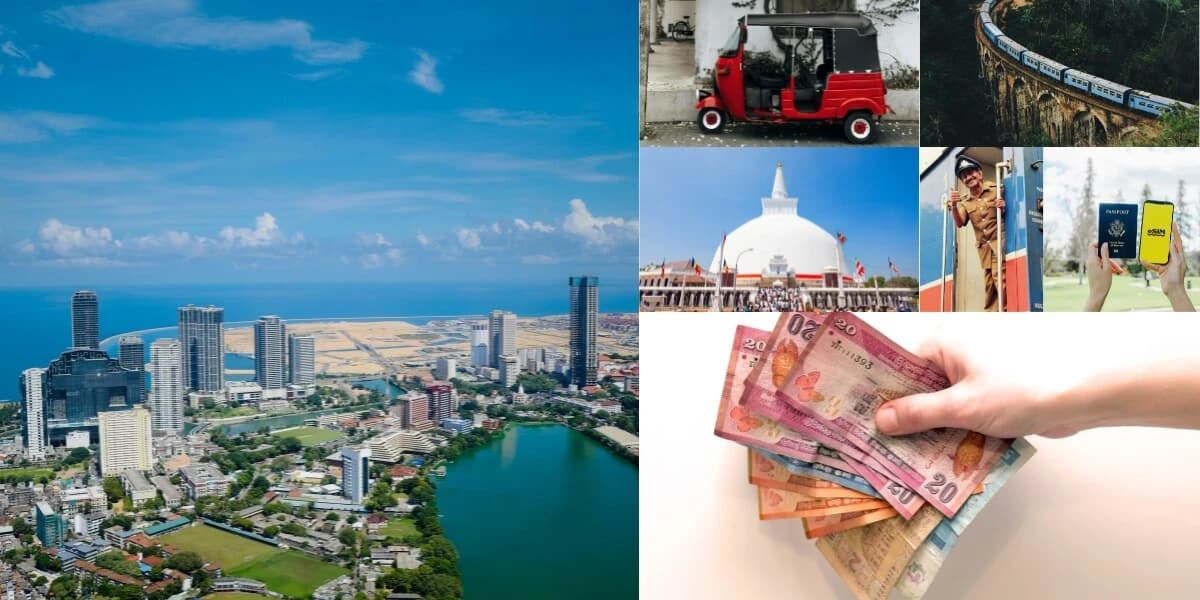
Credit cards work at hotels, larger restaurants, and some tourist shops. Everywhere else — tuk-tuks, local restaurants, market stalls, temple donations, bicycle rentals, small guesthouses, bus conductors — requires cash in Sri Lankan Rupees (LKR).
ATMs are widely available in towns and cities (Commercial Bank, Sampath Bank, and HNB are the most reliable for foreign cards). But they disappear in rural areas, national parks, and smaller villages. The rule: withdraw cash whenever you see an ATM, not when you need one.
2. Break Big Bills Early
ATMs typically dispense 5,000 LKR notes. Many small vendors, tuk-tuk drivers, and ticket counters don't carry change for large denominations. Break your big notes at supermarkets, petrol stations, or hotel front desks. Carrying a supply of 100, 500, and 1,000 LKR notes makes daily transactions vastly smoother.
3. Tipping Is Appreciated but Not Expected
Sri Lanka doesn't have the tipping culture of the US, but small tips are welcomed and make a meaningful difference to people earning local wages.
Restaurants: 10% if service charge isn't already included (check the bill — many tourist restaurants add it automatically). For local rice-and-curry shops, rounding up or leaving 50–100 LKR is generous.
Tuk-tuk drivers: Not expected for short rides. For a driver who's been particularly helpful or has waited for you, rounding up the fare or adding 100–200 LKR is kind.
Hotel staff: 200–500 LKR for porters or particularly attentive housekeeping.
Safari drivers/guides: 500–1,000 LKR per person is standard. More if they found you a leopard.
Private drivers (full-day or multi-day): 1,000–2,000 LKR per day is typical and expected.
4. The Exchange Rate Fluctuates — Use a Currency App
As of early 2026, $1 USD ≈ 290–310 LKR. But this fluctuates. Download XE Currency or a similar converter before you arrive. It takes three seconds to check whether a quoted price is reasonable, and it prevents the slow-dawning realisation that you paid $15 for a $3 tuk-tuk ride.
Connectivity
5. Buy a SIM Card at the Airport
This is the single best piece of practical advice for Sri Lanka. A local SIM card (Dialog or Mobitel are the main providers) costs $5–10 at the airport and gives you a month of data, local calls, and — critically — the ability to use PickMe, Google Maps, and messaging apps.
The airport SIM counters are open for arriving flights and the process takes 10 minutes. Bring your passport (required for registration). If your phone supports eSIM, you can also purchase one before departure through providers like Airalo or Saily.
Why it matters: Without data, you can't use PickMe (the ride-hailing app that eliminates every tuk-tuk pricing argument), you can't check Google Maps (essential for navigating bus routes and walking directions), and you can't check train schedules on the fly.
6. Wi-Fi Is Everywhere (Sort Of)
Almost every guesthouse, hotel, and tourist-oriented café offers free Wi-Fi. Quality varies dramatically — fast in Colombo, acceptable in tourist towns, unreliable in rural areas. Don't rely on Wi-Fi alone. The SIM card with data is your backup for everything.
Getting Around
7. Download PickMe Before You Land
PickMe is Sri Lanka's ride-hailing app — the local equivalent of Uber or Grab. It works for tuk-tuks and cars, shows you the fare upfront, and eliminates the need to negotiate with every driver.
It works well in Colombo, Kandy, Galle, and most tourist areas. It's less reliable in rural areas and parts of the south coast, where local tuk-tuk drivers resist ride-hailing apps.
Even when PickMe doesn't work locally, check the app for an estimated fare before negotiating with a street tuk-tuk. It gives you a fair-price reference point, and showing the screen to a driver signals that you know what the ride should cost.
8. Agree on a Fare Before Getting In
For any tuk-tuk ride not booked through an app: agree on the price before you sit down. If a driver says his meter is broken, either insist on using it, check the PickMe rate and negotiate based on that, or find another driver. There are always other drivers.
A rough benchmark: 100 LKR ($0.35) per kilometre for short trips in tourist areas. Longer journeys cost proportionally less per kilometre.
9. Buses Are Cheap and Terrifying
Sri Lankan buses are the cheapest form of transport on the island. A 100-kilometre journey can cost less than $0.50. They're also crowded, loud, and driven with a confidence in physics that most passengers do not share.
Red government buses are the cheapest and slowest. Private buses (white or coloured) are marginally faster and slightly more expensive. Neither is air-conditioned on most routes.
Use buses for short hops between nearby towns. For long cross-country journeys, trains or a private car are less stressful.
10. Trains Are Wonderful but Slow
Sri Lanka's train network runs on colonial-era tracks at colonial-era speeds. The Kandy-to-Ella line is one of the world's great scenic train rides, but it takes 7 hours for a journey that would be 3 hours by car.
Book reserved seats 30+ days in advance through the official Sri Lanka Railways portal. Second class reserved ($2) is the sweet spot — guaranteed seats, openable windows, and the ability to lean out and feel the breeze.
Safety and Scams
11. Sri Lanka Is Safe — With Normal Precautions
The U.S. State Department maintains a Level 2 advisory ("Exercise Increased Caution") for Sri Lanka — the same level as France, Italy, Germany, and the UK. Violent crime against tourists is rare. The vast majority of visitors have trouble-free trips.
The real risks are not dramatic: they're scams, tuk-tuk overcharging, petty theft in crowded areas, and the tropical sun. Handle those and you'll be fine.
12. The Scams You'll Actually Encounter
Sri Lanka's scams are annoying, not dangerous. Here are the most common:
The Tuk-Tuk Detour: A friendly stranger tells you there's a "special festival" or "free exhibition" happening nearby and offers to take you there. A tuk-tuk conveniently appears. You end up at a gem shop or spice garden where you're pressured to buy. The stranger and driver split the commission. Solution: decline unsolicited offers from strangers who appear too interested in your day.
The Broken Meter: A tuk-tuk driver claims his meter isn't working and quotes an inflated price. Solution: use PickMe, or agree on a price before entering the tuk-tuk based on your knowledge of fair rates.
The Spice Garden Hard Sell: Tour drivers receive commissions for bringing tourists to certain spice gardens between Kandy and Dambulla. The visit starts friendly and ends with a "doctor" pressuring you to buy expensive herbal remedies. Solution: if you want to visit a spice garden, go for the experience but set a firm spending limit before you enter. You are never obligated to buy.
The Gem Investment: You're told you can buy gemstones cheaply in Sri Lanka and sell them at home for a profit. The gems are overpriced, often fake, and the "investment" is a scam. Solution: never buy gemstones unless you're a qualified gemologist or buying from a certified dealer for personal use only.
The Stilt Fisherman Photo Trap: Along the south coast near Koggala and Ahangama, men pose on stilts in the water pretending to fish traditionally. After you photograph them, associates on shore demand payment. Solution: know that this is a setup, not a spontaneous cultural moment. If you want the photo, ask about the fee first. If you don't, walk past.
The Surfboard Damage Scam: After renting a surfboard, the shop claims you damaged it and demands a large repair fee. Solution: photograph the board from all angles before and after your session.
13. Women Travelling Solo: Practical Advice
Sri Lanka is generally safe for solo female travellers, and many women travel the country without incident. However, verbal harassment and unwanted attention do occur, particularly in less-touristed areas.
Practical steps: use PickMe rather than hailing street tuk-tuks at night. Stick to well-lit, populated areas after dark. Dress modestly outside beach areas (this reduces unwanted attention significantly). Trust your instincts — if a situation feels uncomfortable, leave. Sri Lankan women commonly travel on buses and trains during the day, and you can too; some train routes have female-only carriages.
Health
14. Don't Drink the Tap Water
Tap water in Sri Lanka is not safe for drinking. Bottled water is cheap (30–60 LKR / $0.10–0.20) and available everywhere. Use bottled water for drinking and brushing teeth. Ice in tourist restaurants is generally made from purified water and is safe.
15. Mosquito Repellent Is Not Optional
Dengue fever is present in Sri Lanka, with increased risk during monsoon seasons. There is no vaccine for dengue — prevention means avoiding bites. Use repellent containing DEET (20–30%) or picaridin, particularly during dawn and dusk when Aedes mosquitoes are most active. Long sleeves and trousers in the evening help.
16. Pack a Basic Medical Kit
Pharmacies exist in towns but are sparse in rural areas and may not stock what you need. Bring: paracetamol/ibuprofen, rehydration salts (the heat and spicy food can cause dehydration), anti-diarrheal medication, plasters, antiseptic cream, and any prescription medications you take regularly.
17. The Sun Will Get You Before Anything Else
Sunburn is the most common tourist health complaint in Sri Lanka — more common than stomach issues, mosquito bites, or anything else. The country sits just north of the equator. The UV index is extreme. SPF 50. Reapply after swimming. Wear a hat. Drink water constantly. The people who ignore this advice know it by the end of Day 2.
Culture and Etiquette
18. Cover Up at Temples
Every Buddhist and Hindu temple requires visitors to cover their shoulders and knees. This applies to everyone regardless of gender. Shoes must be removed before entering temple buildings (the stone can be scorching hot in midday sun — socks help).
Carry a lightweight long-sleeved shirt or sarong in your day bag. You'll need it repeatedly, and being turned away at the entrance because you're wearing shorts is frustrating when you've travelled hours to get there.
19. The Right Hand Rule
In Sri Lankan culture, the left hand is considered unclean. Use your right hand when eating (if eating with hands, which is traditional), when handing over money, and when giving or receiving items. This is a cultural norm, not a strict rule — nobody will be offended if you forget — but observing it shows respect.
20. Photographs: Ask Before Shooting
Sri Lankans are generally happy to be photographed but it's polite to ask first, especially at religious sites and in rural areas. Never photograph military installations. Photography is prohibited at the Sigiriya frescoes. Drone regulations are strict near temples (including the Temple of the Tooth in Kandy) and military areas.
21. Sri Lankans Are Genuinely Friendly
This isn't a travel-blog platitude. Sri Lankans are, on the whole, remarkably welcoming to visitors. You will be invited into homes. You will be offered tea. Strangers will go out of their way to help you find a bus stop or correct a wrong turn. Accept the kindness gracefully. The overwhelming majority of human interactions in Sri Lanka are exactly what they appear to be: people being kind.
The exception is tourist-heavy zones where touts and commission agents operate. Learn to distinguish between genuine friendliness (which is the norm) and commercial approaches (which are limited to specific locations).
Practical Essentials
22. Essential Apps to Download
PickMe — Ride-hailing for tuk-tuks and cars. The most important app on your phone.
Google Maps — Works well for navigation, walking routes, and finding restaurants. Offline maps are available for download (useful when you lose signal in rural areas).
XE Currency — Real-time currency conversion. Invaluable for quick price checks.
Google Translate — Sinhala and Tamil language packs can be downloaded for offline use. Useful for reading menus, signs, and having basic conversations in areas where English is limited.
Booking.com or Agoda — For last-minute accommodation. Both have extensive Sri Lanka listings.
23. Power Adapters and Electricity
Sri Lanka uses Type D (three-round-pin) and Type G (British three-pin) plugs. Voltage is 230V. Bring a universal travel adapter. Power cuts still happen occasionally, particularly during storms or in rural areas. A portable phone charger is worth carrying.
24. What to Pack (and What Not To)
Pack: Light, breathable clothing. One warm layer for the Hill Country (it drops to 10–15°C above 1,000m — this catches everyone off guard after days in 30°C heat). Modest clothing for temples (shoulders and knees covered). Comfortable walking shoes. Sandals for beach and easy temple on/off. Sunscreen SPF 50. Mosquito repellent. Rain jacket or poncho (compact, not an umbrella — more practical in tropical downpours). Portable charger. Reusable water bottle with filter if you want to reduce plastic waste.
Don't pack: Formal clothing (not needed anywhere). Excessive quantities of anything — Sri Lanka has pharmacies, supermarkets, and shops where you can buy toiletries, sunscreen, and clothing cheaply if you run out.
25. Learn Three Sinhala Words
You don't need to learn Sinhala — English is widely spoken in tourist areas. But three words will transform interactions and draw genuine smiles:
"Ayubowan" (ah-yu-BOH-wan) — The traditional greeting, meaning "may you live long." Use it when entering shops, meeting people, or arriving at your guesthouse.
"Bohoma sthuthi" (BOH-ho-ma STOO-tee) — Thank you. Use it everywhere, constantly.
"Harima hondai" (HAH-ri-ma HON-dye) — Very good. Use it after meals, at the end of a tuk-tuk ride, or whenever someone has done something kind. Which will be often.
26. April Is Complicated
The Sinhala and Tamil New Year falls around April 14th. It's a beautiful celebration — the most important cultural event in the Sri Lankan calendar. Families gather. Traditional games are played in the streets. Special foods are prepared.
It's also a logistical challenge for tourists. Shops close. Restaurants close. Transport options shrink. Trains and buses book out. Accommodation prices rise. If you're visiting in mid-April, embrace the festival spirit — but book everything in advance and expect a slower pace.
27. Sri Lanka Time Is a Real Thing
"Sri Lanka Time" is the local term for the pace at which things happen. Buses leave when they're full, not when the schedule says. Trains are routinely 30 minutes to 2 hours late. Restaurants bring food when it's ready, not when you expect it. A "10-minute wait" means 20. A "short drive" means 45 minutes.
This is not inefficiency. It's a different relationship with time. The travellers who enjoy Sri Lanka most are the ones who stop fighting it. Build buffer time into every day. Leave margins in your itinerary. And when something takes twice as long as expected, use the extra time to look around — because whatever you see while waiting will probably be worth noticing.
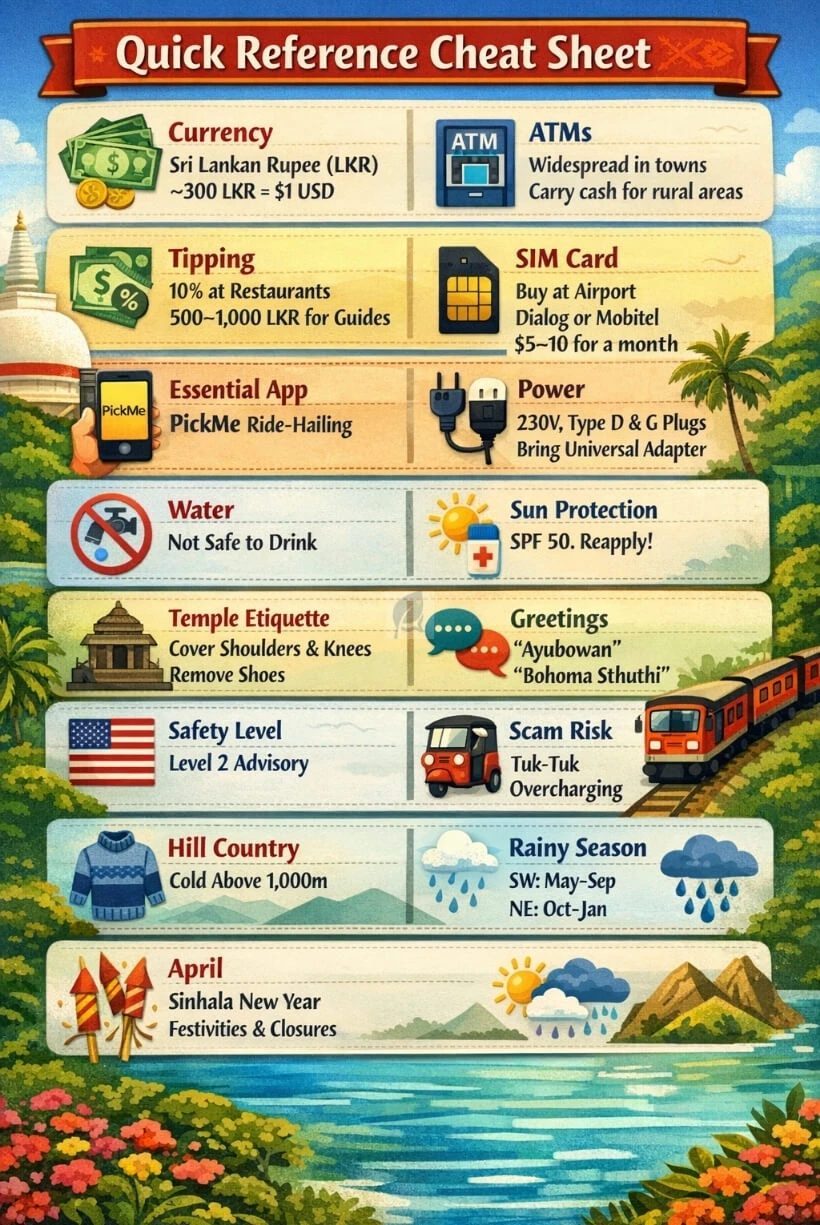
Quick Reference Cheat Sheet
The Bottom Line
Sri Lanka is not a difficult country to travel in. It's not dangerous, it's not expensive, and it's not complicated — once you know the handful of things that the country itself won't tell you.
Get the SIM card. Download PickMe. Carry cash in small denominations. Cover your knees at temples. Put on sunscreen before you think you need it. And when a stranger invites you for tea, say yes — because that invitation is almost certainly genuine, and the tea will be excellent.
The scams are minor. The inconveniences are temporary. The kindness is everywhere. And the things you'll remember from Sri Lanka won't be the tuk-tuk argument on Day 1 — they'll be the sunrise from Pidurangala, the curry you couldn't stop eating, the train ride where a stranger shared his lunch, and the moment you stopped planning and started living on Sri Lanka Time.
This article is part of our comprehensive Sri Lanka travel series. For detailed planning guides, see our articles on visas, the best time to visit, the 10/14-day itinerary, and individual guides to the train, beaches, food, Cultural Triangle, and Yala safari.
Key Takeaways for Quick Reference:
Buy a SIM card at the airport — Dialog or Mobitel, $5–10, essential for PickMe and maps
Download PickMe before landing — it eliminates every tuk-tuk pricing argument
Carry cash in small bills — ATMs give 5,000 LKR notes; vendors need 100s and 500s
Cover shoulders and knees at temples — carry a sarong or light long-sleeved shirt
SPF 50 sunscreen is the single most important thing in your bag
Tipping: 10% at restaurants, 500–1,000 LKR for safari guides, not mandatory for tuk-tuks
Scams are annoying, not dangerous — decline unsolicited offers, use PickMe, photograph surfboards
Don't drink tap water — bottled water costs $0.10–0.20
Mosquito repellent with DEET — dengue prevention, especially dawn and dusk
Bring a warm layer for the Hill Country — it drops to 10–15°C at altitude
April: Sinhala New Year is beautiful but everything closes — book ahead
Safety: Level 2 advisory, same as most of Western Europe. Exercise normal precautions.
Learn three words: Ayubowan (hello), Bohoma sthuthi (thank you), Harima hondai (very good)