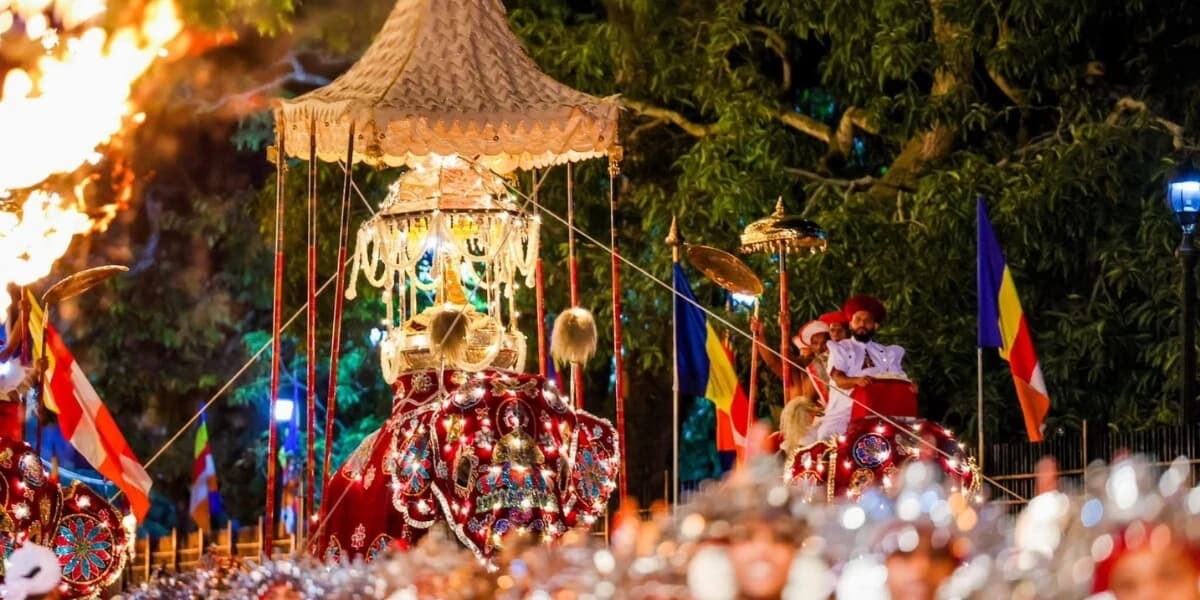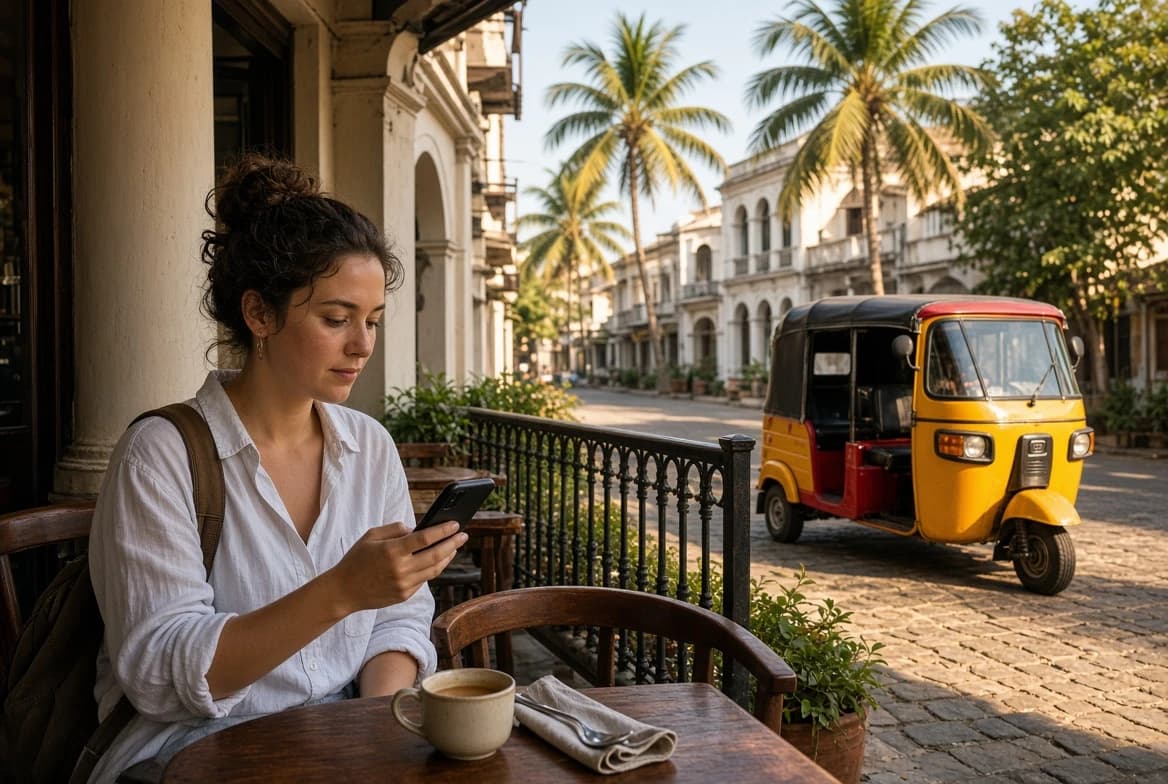
Sri Lanka is not a dangerous country for visitors. Violent crime against tourists is rare. Most people who smile at you mean it.
What you will meet, especially in Colombo, Kandy, Galle and around the big sights, is a small set of money tricks that have been running for years. Tuk-tuk quotes that start three times too high. A “closed temple” that is open. A free ride that ends in a gem shop. A spice garden where the oil costs more than the hotel.
This is not a fear piece. It is a list of the patterns that leak cash, and the boring habits that stop them. Pair it with the fair-price driver guide if you are hiring a car for the week.
Quick answer
Most “scams” here are commission, not crime.
Someone steers you. A shop overcharges. A driver takes a cut. You can walk away at every step.
The one rule: if help arrived unasked, and the next stop is a shop, a “special price,” or a cousin’s factory, you are in the script. Say no. Keep walking. Use PickMe, a licensed driver, or your own map.
Tourist Police and SLTDA sit behind 1912. Police emergency is 119. Ambulance is 1990. Women and Child Bureau is 109.
What is actually common
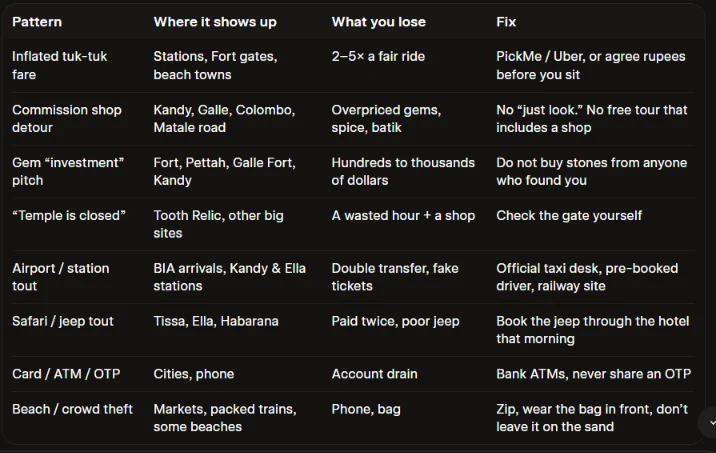
None of this means stay in the hotel. It means decide the destination before you get in the vehicle.
Before you fly: the visa site
The first leak can happen at a kitchen table.
The official electronic travel authorisation is eta.gov.lk. Lookalike domains and “we’ll file it for you” WhatsApp agents charge two or three times the real fee, or take the money and file nothing. From 25 May 2026 many nationalities get a free 30-day tourist ETA — they still have to apply on the government site. Under-12s are free. Apply yourself. Type the address. Do not follow an ad.
Airport: the first five minutes
Bandaranaike (CMB) is where tired people overpay.
Touts work the arrivals hall and the kerb. They are not the hotel. They are not the official taxi desk. A “special price in dollars” to Colombo is often two or three times an app or prepaid counter fare.
Do this.
Walk past the first smile.
Use the official taxi counter, a pre-booked licensed driver with your name on a board, or PickMe / Uber if a car actually accepts.
For a departure flight, do not gamble on an app at 4am. Pre-book the car the night before.
Tuk-tuks are not supposed to pick up at the airport terminal. Anyone who says otherwise is selling a ride, not quoting a rule.
Tuk-tuks: the daily leak
Most drivers are working. A minority treat foreigners as a different price list.
Street quotes in tourist pockets regularly run three to five times a fair hop (short town rides are often a few hundred rupees, not a few thousand). Galle Fort ranks and some beach strips behave like informal cartels.
The habits that work.
Download PickMe before you land. Uber works in the bigger towns. The fare is on screen before you sit.
No app (Ella, small east-coast towns): agree the price in rupees, for the whole vehicle, before you get in. Then repeat it.
Carry LKR 100, 200 and 500 notes. The “no change” trick loves a 1,000.
“Meter broken” means walk to the next one, or open the app.
A ride that is strangely cheap is not kindness. It is a shop stop.
Night rides: keep the bag on your lap, not in the open side. Agree the hotel name, not “near the Fort.”
Private drivers and the shop circuit
This is the cousin of the tuk-tuk detour, stretched over a week.
A good licensed driver is the most comfortable way around the island. A commission driver is a moving sales funnel: spice garden outside Matale, gem showroom, batik “factory,” tea shop that is a warehouse. You are not forbidden from stopping. You are paying the markup that funds the driver.
Write the rule into the hire. No shopping stops unless you ask. See the fair-price driver guide for what a day should cost when fuel and the driver’s bed are included. If the quote is far below that band, the money is coming from shops.
Licensed chauffeur-guides carry SLTDA credentials. Ask to see them. One driver for the whole trip is fine if you chose them. A new “friend” each morning is how the circuit restarts.
Gems: the expensive one
Sri Lanka mines real sapphires. That fact is the bait.
The usual play: a friendly stranger, sometimes over two conversations, mentions a family workshop, a tax-free export day, a cousin who needs to sell, or a stone you can “resell at home.” The shop produces a certificate printed in the back room. The price has the driver’s 30–40 percent already in it.
If you did not walk into that shop on purpose, do not buy.
If you actually want a stone:
Use a dealer registered with the National Gem and Jewellery Authority (NGJA).
Treat a shop certificate as marketing. Independent testing exists in Colombo.
Never buy as an “investment” on holiday. Buy a thing you like at a price you can lose.
Galle Fort jewellery streets, Kandy near the lake, and Colombo Fort / Pettah are where the pitch is thickest.
Spice gardens, batik and “factories”
The Matale road between Kandy and Dambulla is lined with spice gardens that run on coach and driver commission. The tour is real. The hard sell after it is the point. Prices can sit many times above a supermarket or a town Ayurveda shop.
Same pattern: batik, wood carving, cashew, tea “estate shop” that is a warehouse with a tasting table.
You can visit. You can also say “no shops today” at breakfast and mean it. If the driver sulks, you hired the wrong driver.
Temples, unofficial guides, fake closures
Someone at the approach to the Temple of the Tooth, Sigiriya or another ticketed site tells you it is closed, that you need a special ticket, or that they are the official guide. Then a shop appears.
The temple is usually open. Licensed site guides carry SLTDA cards. Ticket counters sit at the gate.
Decline the escort. Walk to the official entrance. At the Tooth Relic, pay the posted foreigner rate (recently around LKR 2,000 for an adult) at the counter, not to a helper on the pavement. Sigiriya is a Central Cultural Fund ticket — look at the board (foreign adults have been around US$35 in 2026) and take the printed stub. You do not need a path-side guide to buy one.
Donation envelopes and “charity papers” on the street are optional. If you want to give, give inside the temple office or not at all.
Trains: touts and fake certainty
The hill-country train is worth doing. The ticket market around it is messy.
Reserved seats on the pretty carriages sell out. Touts and some third-party sites resell at several times face value, or sell a “Kandy–Ella” ticket for a section that is not running that week. After Cyclone Ditwah in late 2025 the line was broken in places; by 2026 parts had reopened in stages. That confusion is still useful to anyone selling certainty.
Book on the official railway site (passport number for foreigners), or accept unreserved second or third class on the day. Arrive early. The view from an unreserved window is still the view.
In September 2026, AI images circulated of a fully lit Nine Arch Bridge at night. The lighting project was not finished. That is a small modern cousin of the old tout: a picture that sells a visit that isn’t there yet.
Safaris and day tours
Tissa bus stand, Ella guesthouses and Habarana parking lots produce the same man: he knows a jeep, tickets must be paid tonight, the park is booked out unless you use his cousin.
Park entry is bought at the gate. A decent hotel or a known operator books the jeep for the morning. You do not hand over the full cash the evening you arrive to a stranger at the station.
If someone “collects the entrance fee” in advance, you are paying him, not the Department of Wildlife Conservation.
Money, cards and phones
Use ATMs inside banks or malls. Standalone machines in Pettah and some tourist strips are the ones to skip.
Cover the keypad. Do not let the card out of sight in a restaurant.
The Central Bank has been warning through 2026 about phone and social-media fraud: customs fees on a parcel, foreign-job deposits, requests for PIN, CVV or OTP. No official will ask you for an OTP.
Count exchange on the counter. Use a bank or a marked exchange booth, not a man with a calculator on the pavement.
Keep a photo of your passport in the cloud. Keep the paper copy separate from the real thing.
Petty theft and the street
Phones and bags walk in crowded markets, packed trains and some beach strips after dark. Snatch-and-grab from a passing motorbike happens. It is not the main story of a Sri Lanka trip. It is five seconds of inattention.
Bag in front on the bus. Nothing on the back of a chair in a beach café. Don’t leave the phone on a towel while you swim. Isolated beach at night is a poor plan, especially around the busier south-coast towns. Official travel advice still flags drink spiking in some beach-bar strips: buy your own, watch it. A chained “baby elephant” or lead macaque for a selfie is both a welfare trap and a fee trap. Don’t pay, don’t pose.
Traffic will scare you more than crime. Look twice. Buses do not.
Solo travellers, briefly
Plenty of women do this circuit alone. The usual friction is comments and persistence, not assault. Walk away early. A licensed driver for intercity hops reduces the tuk-tuk negotiation load. Dress for temples the same way everyone else should: shoulders and knees covered when it matters.
If someone will not leave you, move into a shop or a hotel lobby and call 1912.
If something already happened
Stop paying. You do not have to “finish the tour.”
Call 1912 (SLTDA line; they can reach Tourist Police). Police emergency is 119.
Tourist Police Division, Colombo: +94 11 242 1052. There are posts at the airport, in Colombo, Kandy and other hubs.
Card gone? Call the bank first, police second.
You need a report number for insurance. Ask for it.
A bad tuk-tuk quote is usually not worth a station visit. A gem purchase measured in thousands of dollars is.
A short safe-practice list
PickMe or a pre-agreed rupee fare. Every time.
Destinations you chose. Shops you walked into.
SLTDA licence on a multi-day driver.
Official railway site, or unreserved on the day.
Bank ATM. No OTP to a stranger.
1912 in the phone before you need it.
Small notes. Zip. Early exit from a pitch.
Friendliness is real here. So is commission. You can accept the first and refuse the second without being rude. “No thank you” is a complete sentence in any language.
Frequently asked questions
Where do I apply for the ETA?
Only eta.gov.lk. Type it yourself.
Is Sri Lanka safe in 2026?
For typical visitors on the south, hill and Cultural Triangle circuit, yes. The everyday risks are traffic and overcharging, not violence.
Should I use tuk-tuks at all?
Yes. Use the app where it works. Agree the fare where it doesn’t.
Can I buy gems?
Yes, if you came for gems and you choose an NGJA-registered dealer. No, if a new friend walked you there.
What if a driver says the temple is closed?
Go to the gate. Closed-day rumours are a sales tool.
Is PickMe safe at the airport?
It can work. Touts are faster than the app. A pre-booked driver is calmer. Do not rely on a last-minute app for a departing flight.
Who do I call?
1912 for tourist help. 119 for police emergency. 1990 for ambulance. 109 for the Women and Child Bureau.
The short version
Nobody needs you frightened of Sri Lanka.
They need you slightly harder to steer. Price the ride before you sit. Choose the shop yourself. Keep the OTP. Walk to the real ticket window.
That is most of the job.