Sri Lanka does not have one rainy season. It has two monsoons on opposite coasts.
That is the whole planning problem, and the whole solution. Weather here does not usually cancel the holiday. It cancels the wrong activity on the wrong shore. Swim week in Mirissa in July is a poor idea. The same week in Nilaveli is why people come in August. A cancelled whale boat in the south is often a running boat in Trincomalee.
This is the activity version of that map-flip. What rain, wind, swell and heat actually do to swimming, surf, whales, safari, trains, hill walks and temple climbs — and what still works when the sky opens.
If you only needed August, read that month’s weather guide first. This piece is the year-round rulebook.
The two-monsoon rule
Yala / southwest monsoon, roughly May–September.
Wets the west and south coasts and much of the hill country. Opens the east and north. The same wind that chops Bentota is the wind that builds Arugam Bay and fills the Kalpitiya lagoon with kite sailors.
Maha / northeast monsoon, roughly October–January.
Wets the east and north. The south and west dry from November into March. Mirissa whales and Weligama learners get their season.
Inter-monsoon, April and October–November.
Short, sharp storms anywhere. October is the worst single month if whales are the point of the trip — both coasts can be messy at once.
The Cultural Triangle sits in a rain shadow most of the year. Rain is rarely why you skip Sigiriya. Heat is.
Treat the calendar as a starting position, then check this week’s sea and the Department of Wildlife Conservation gate notices. A blog written in January cannot see a Bay of Bengal depression sitting off Trincomalee on a Thursday in September.
What weather actually does to each activity
Swimming and family beaches
This is the activity weather ruins most often, because people book the famous name instead of the safe shore.
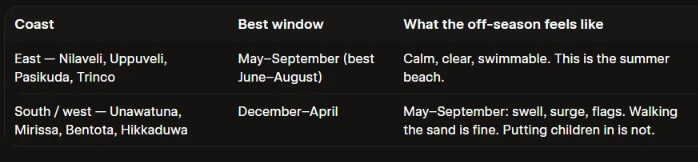
October and April are flip weeks. Look at that morning’s sea, not last year’s postcard.
A wet day on the “wrong” coast is still a Galle Fort day, a long lunch, a temple, a spa. It is not a reason to sit in Unawatuna waiting for July to become January.
Surf
The monsoons do not just wet the land. They aim the swell.
Arugam Bay and the east points: May–October, peak June–August. Main Point is intermediate and up. Whiskey Point and Peanut Farm are where beginners belong.
Weligama, Hikkaduwa, Midigama, Ahangama: November–April.
Do not book a first lesson in Weligama for July. The southwest wind that makes the east work blows the south into chop.
Whale watching
Whales do not leave Sri Lanka. The boats change harbour.
Mirissa: November–April, strongest December–March. Southwest swell shuts this coast.
Trincomalee: about May–September, best June–August, thinning in late September.
October: skip both if whales are the reason you came.
Boats leave at dawn. Take tablets if anyone in the family is even slightly unsure. Nothing is guaranteed. A Met marine advisory beats a hotel brochure.
Snorkel and dive
Visibility follows the dry shore.
Pigeon Island, off Nilaveli: April–October, clearest June–August, often 15–25 metres. Go before 11am.
Hikkaduwa and the south reefs: December–April.
Do not pay for a reef day from a west-coast hotel in July and hope the water clears.
Kitesurf, Kalpitiya
Same southwest wind, different toy.
May–October: 18–25 knots is common, July–August the punchiest. Advanced water.
December–March: lighter, kinder for first sessions.
April and November: often limp. Do not build a kite week on those two months.
Safari
Dry weather concentrates animals at water. Rain does not empty a park. It softens the tracks and can close a gate.
Minneriya and Kaudulla Gathering: July–October, building through August, often peaking in September. Afternoon jeeps. Here the dry season is the spectacle.
Yala leopards: density is usually strongest February–June. Crowds peak December–March. In 2026, Blocks 1 and 2 close 14 September–15 October for drought recovery, not because the park is flooded. Blocks 3–6 can still run. Check the official Yala site the week you travel.
Wilpattu: the smarter May–September leopard alternative when Yala is crowded or half-shut.
Udawalawe: the nearest thing to a year-round elephant park when other gates wobble.
First jeep at opening. Midday heat on open rock is a harder limit than drizzle.
Parks also close after heavy rain or for drought stress. In early September 2026 the Department of Wildlife Conservation stood down several sites after rainfall. Treat a booking as a plan, not a contract with the sky.
Hills, trains and walks
Kandy–Ella train: runs all year when the line is open. December–March gives the postcard views. May–September gives mist, showers and a moodier valley. Reserved seats still matter. Landslides cancel services — they did after Cyclone Ditwah in late 2025, and rockfalls still close bits of the hill road. Have a driver as backup.
Horton Plains / World’s End: dawn, or accept white. Best chance of a view December–March. After 9am in the southwest monsoon you are often looking at cloud.
Little Adam’s Peak and Ella Rock: year-round if you keep a spare morning. Trails slick up fast.
Adam’s Peak / Sri Pada: official pilgrim season from the December poya to Vesak in early May. Lights, stalls, a real sunrise chance. February–March is the cleanest window. Outside season the path is darker, wetter and emptier. Do not treat August as a sunrise hike.
Tea country in the southwest monsoon is green on purpose. Pack a layer and walk between showers. That is not a failed hill day.
Culture and heat
Sigiriya and Pidurangala: open most of the year. Climb at opening. April is a furnace. Late August sun sits nearly overhead. A forty-minute cell of rain is an inconvenience. Eleven o’clock on bare stone is the real problem.
Anuradhapura and Polonnaruwa: same rule. Early, water, hat.
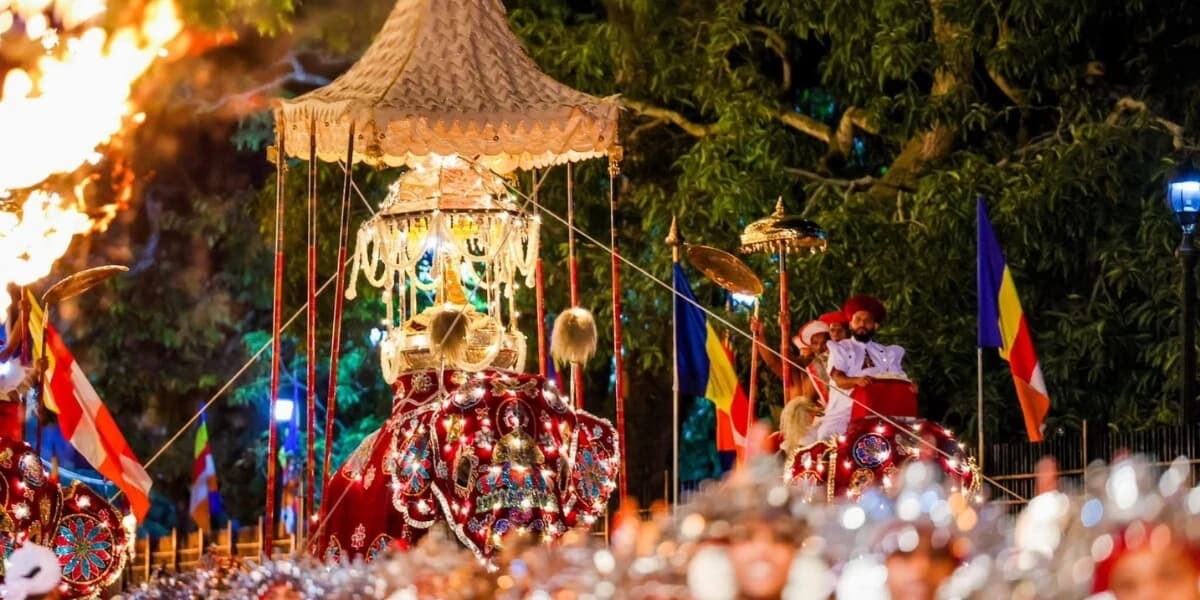
Kandy Esala Perahera: date-driven, not weather-driven. Light rain does not stop it. Poncho, not umbrella.
Galle Fort: showers do not kill a walking town. This is what the wet south is for in June.
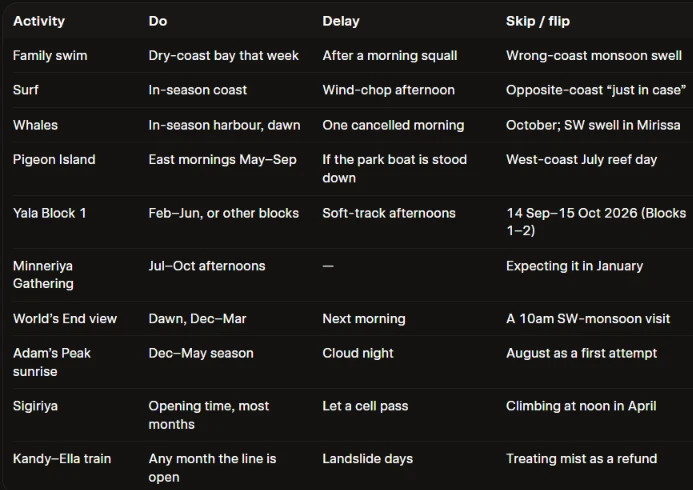
Do, delay, or skip
Two itineraries that respect the weather
December–March. South and west beaches, Mirissa whales, hill walks with a view, Adam’s Peak if you want the climb, Yala while Block 1 is open, Cultural Triangle in the morning. This is the classic first-timer loop.
May–September. Cultural Triangle early, east-coast swim or surf, Trincomalee whales, Minneriya in the afternoon, Kalpitiya if you kite, Wilpattu or Udawalawe instead of betting everything on Yala Block 1. Use Galle and the west as a food-and-fort connector, not as the swim week.
October is the awkward child. East is turning. South is not fully dry. Yala Block 1 is often shut. Keep a spare indoor day and a coast you can abandon.
A wet day that is still a good day
Cave temples at Dambulla. Galle Fort walls and a museum. A tea factory. A cooking class. The Temple of the Tooth. A long lunch. A spa afternoon. The train, if it is running and you already have seats.
What does not work is burning five days on a monsoon beach waiting for the photograph you saw in January.
Pack for the problem, not the hope
Reef-safe SPF 50, bought before you fly. East-coast sun in July is not gentle.
Compact rain layer, always. Umbrellas lose in crowds and on jeep tracks. Ponchos do not.
Light fleece for the hills. Nuwara Eliya evenings are not Colombo evenings.
Dry bag for boats and sudden cells.
Electrolytes. The Triangle in April and August will use them.
Leave the jeans.
2026, in one paragraph
The southwest monsoon into early September 2026 behaved like the script: showers on the west, Sabaragamuwa and the hills, a generally drier east. A late-August swell advisory made south-coast swimming a bad idea for a few days. Hill rain still closes roads and, sometimes, trains. Yala’s 2026 Block 1 and 2 closure is a drought recovery, which is a useful reminder that “safari weather” cuts both ways. None of that means skip Sri Lanka. It means lock the activity to the coast that is dry this week.
Frequently asked questions
Does rain ruin a Sri Lanka trip?
No. Booking the wet coast for a swim week does.
Can we swim in Mirissa in August?
Some days look fine from a café. The sea is often not. Put the swim week on the east.
When do the whales switch coasts?
Mirissa roughly November–April. Trincomalee roughly May–September. October is the gap.
Is the Kandy–Ella train cancelled in monsoon?
Not as a season. Individual days and sections close after landslides. Check Sri Lanka Railways and keep a driver as plan B.
Is Yala closed in 2026?
Blocks 1 and 2 close 14 September–15 October 2026. Other blocks and other parks may be open. Confirm before you drive to Tissa.
Is World’s End worth it in the southwest monsoon?
Only if you go at dawn and accept that the drop may be white.
What do we do on a rainy west-coast day?
Fort, food, temple, tea, train. Not five hours of hoping the flags come down.
The short version
Pick the activity. Then pick the coast that weather is serving that month.
Southwest monsoon: east swim, east surf, Trinco whales, Gathering, kite.
Northeast monsoon: south swim, south surf, Mirissa whales, clearer hills, Adam’s Peak.
Heat kills temple climbs at noon. Rain mostly delays them. Swell is what actually sends you home early from a beach.
Flip the activity, not the holiday.
Places Mentioned(9)
Sigiriya
Sigiriya, Sri Lanka
Pidurangala Rock
Sigiriya, Sri Lanka
Yala National Park - Block VI
ලුනුගම්වෙහෙර ජාතික උද්යානය, Thanamalwila 91300, Sri Lanka
Minneriya National Park
Sri Lanka
Sri Dalada Maligawa
Kandy
Nine Arches Bridge
Ella, Sri Lanka
Horton Plains National Park
Sri Lanka
Little Adam's Peak
Little Adam's Peak, Sri Lanka
Sri Pada / Adam's Peak
Sri Pada / Adam's Peak, Sri Lanka
Tap a place card to see more details • Swipe to see all 9 places