Forget What You Think You Know About Sri Lankan Food
Most first-time visitors to Sri Lanka make the same mistake. They arrive expecting Indian food with a beach view.
This is like arriving in Portugal expecting Spanish food with better sardines. The ingredients overlap. The geography is close. The flavour profiles share DNA. But once you sit down to your first proper Sri Lankan rice and curry — a plate surrounded by eight or ten small dishes, each one a different colour, texture, and degree of heat — you realise you're dealing with something that has its own language entirely.

In 2025, Condé Nast Traveler's Readers' Choice Awards ranked Sri Lanka seventh in the world for food, placing it alongside France, Italy, and Thailand. This didn't surprise anyone who had eaten there. It surprised people who hadn't.
The island's cuisine is built on three pillars: rice, coconut, and spice. That sounds simple. It is not. From those three foundations, Sri Lankans have engineered a food culture so varied that a family could eat rice and curry for lunch every day of the year and never repeat the same combination of dishes.
Colonisation layered Dutch, Portuguese, and British influences on top of a Sinhalese and Tamil base. The Malay community brought watalappan. The Moors contributed biriyani and its dozens of regional variations. The Burghers — descendants of Dutch-Sri Lankan intermarriage — created lamprais, which may be the most elaborate packed lunch in human history.
This guide covers the dishes you need to eat, where to find the best versions, and how to navigate Sri Lanka's food scene without accidentally ordering something so spicy it restructures your afternoon.
The Essentials: Dishes You'll Eat Every Day (And Want To)
Rice and Curry
This is the foundation. Not a dish. A system.
A Sri Lankan rice and curry lunch is not one curry served with rice. It is rice — white, red, or brown — served with anywhere from five to twelve different preparations, each in its own small bowl or spread across a banana leaf. There will be a protein (fish, chicken, or egg), a dhal, two or three vegetable curries, one or two sambols, a pickle, a papadum, and possibly a mallum (chopped greens mixed with coconut).

The curries are classified by colour, and the colour tells you something important. White curries are mild, made with coconut milk and turmeric. Red curries carry heat, built on chili powder and tomato. Black curries are dry-roasted, deep, and complex — often the most flavourful thing on the plate.
Every restaurant, every household, and every roadside stall will produce a rice and curry that tastes different from the one you had the day before. The combination changes with the season, the region, the cook's mood, and what was fresh at the market that morning.
Where to eat it: Upali's in Colombo serves a refined, accessible version. But the best rice and curry in Sri Lanka comes from small family-run restaurants on roadsides — the ones with no English sign and a daily menu written on a chalkboard. Point at what looks good. You won't be disappointed.
Cost: LKR 400–800 ($1.30–$2.70) at a local restaurant. LKR 1,500–3,000 ($5–$10) at tourist-oriented spots.
Spice level: Varies enormously. Ask for "less spicy" (ahu kuru) if you're new to the cuisine. Nobody will judge you.
Hoppers (Appa)
If rice and curry is Sri Lanka's lunch, hoppers are its breakfast — and its late-night snack, and increasingly its dinner at restaurants that know what tourists want.

A hopper is a bowl-shaped pancake made from fermented rice flour and coconut milk, cooked in a small, deep-sided wok. The base is thin and crispy. The centre is soft and slightly spongy. The whole thing has a faintly sour tang from the fermentation.
An egg hopper comes with an egg cracked into the centre, cooked until the white sets and the yolk stays runny. You tear off pieces of the crispy edge and use them to scoop up the egg, alongside lunu miris (a hot, salty chili relish) and a curry on the side.
String hoppers (idiyappam) are a different preparation entirely: thin rice noodles pressed through a mould and steamed into flat, circular nests. They're delicate, slightly sticky, and designed to absorb the curries and sambols you pile on top.
Where to eat it: Any guesthouse or hotel breakfast spread will include hoppers. For the real experience, find a hopper stall that operates in the evening — you'll see the cook working the small wok in rapid succession, turning out hoppers every thirty seconds.
Cost: LKR 50–150 ($0.15–$0.50) per hopper at a local stall. LKR 300–600 ($1–$2) at restaurants.
Kottu Roti
The sound comes first. Before you see the dish, you hear it: the rhythmic, percussive clatter of two metal cleavers chopping roti on a flat iron griddle. It's the soundtrack of Sri Lankan street food, audible from a block away, and it draws you in like a dinner bell.
Kottu is chopped roti bread stir-fried with vegetables, egg, and your choice of protein (chicken, mutton, or seafood), seasoned with curry leaves, chili, and garlic. The result is something between a stir-fry and a savoury hash — crispy in places, soft in others, and absolutely packed with flavour.

Sri Lankans treat kottu the way Americans treat burgers: it's fast food, it's everywhere, it's not particularly healthy, and it's incredibly satisfying. Cheese kottu — where processed cheese is melted through the mix — is a more recent innovation and has a passionate following.
Where to eat it: Kottu is best from street-side stalls and small local restaurants. Hotel Nells in Negombo and Hotel de Pilawoos in Colombo are both famous for their versions, but honestly, the best kottu usually comes from the stall with the longest queue and the loudest chopping.
Cost: LKR 400–1,000 ($1.30–$3.30) depending on the protein.
Pol Sambol (Coconut Sambol)
This is not a dish. It's a condiment. But it's such a fundamental part of eating in Sri Lanka that leaving it off this list would be like writing about French food and forgetting to mention bread.

Freshly grated coconut is mixed with chili flakes, red onions, lime juice, and Maldive fish (a dried tuna product that adds depth and umami). The result is simultaneously fresh, hot, salty, and sour. It goes with everything: rice, hoppers, roti, string hoppers, even bread. You will eat it at every meal and miss it when you leave.
Dhal Curry (Parippu)
Sri Lanka's most ubiquitous curry. Split red lentils are boiled until soft, then combined with a tempered mixture of onions, tomatoes, green chilies, curry leaves, and spices, finished with coconut milk. It's creamy, mildly spiced, and appears on virtually every rice and curry plate in the country.

Parippu is the gateway curry — the one that tourists with low spice tolerance can eat comfortably, the one that children are raised on, and the one that Sri Lankans abroad miss most acutely.
The Dishes That Make People Book Return Flights
Ambul Thiyal (Sour Fish Curry)
This is the dish that visiting food writers tend to fixate on, and for good reason. Ambul thiyal is unlike any fish curry you've had anywhere else.
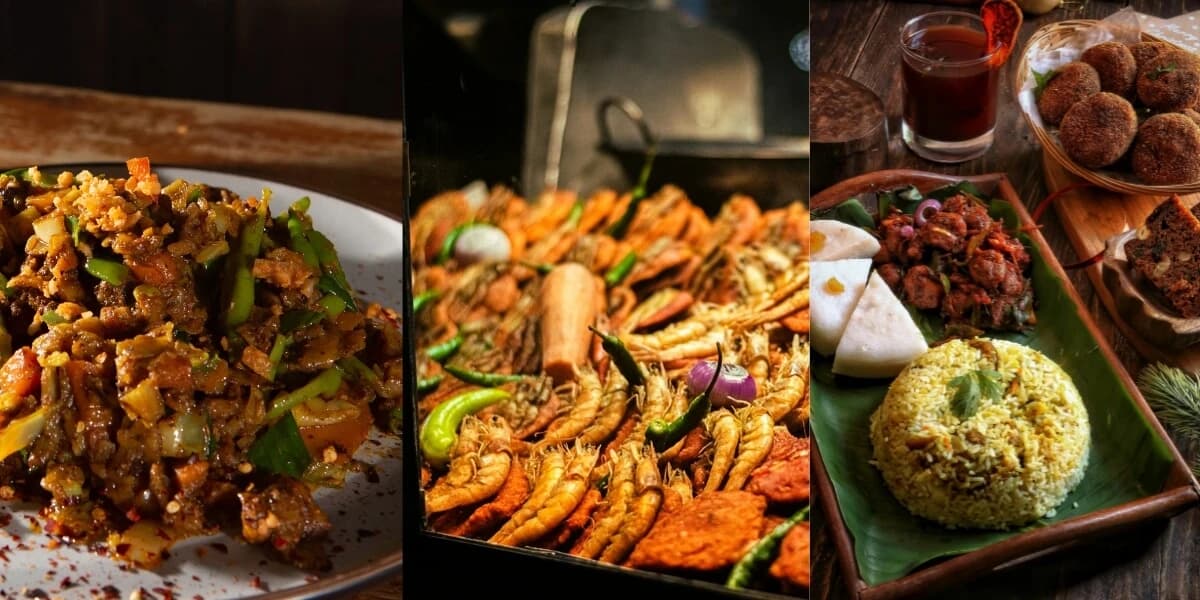
Firm fish — usually tuna — is cut into cubes and dry-cooked with black pepper, cinnamon, turmeric, garlic, curry leaves, and goraka, a tamarind-like fruit native to Sri Lanka that gives the dish its distinctive sour punch. There's no coconut milk. Very little liquid. The spice paste reduces until it coats each cube like a dark, fragrant bark.

Ambul thiyal originated in southern Sri Lanka as a preservation method — the sour coating kept fish edible in the days before refrigeration. Today it's simply one of the most complex-tasting things you'll eat on the island.
Where to eat it: Seafood restaurants along the southern coast between Galle and Mirissa serve it fresh. Ask specifically for ambul thiyal; some menus translate it simply as "fish curry," which doesn't prepare you for how different it is from a standard coconut-milk preparation.
Lamprais
If you eat only one "special occasion" dish in Sri Lanka, make it this one.
Lamprais traces its origins to the Dutch Burgher community and is essentially an elaborately composed meal — rice cooked in meat stock, surrounded by a specific set of accompaniments (a frikkadel meatball, a boiled egg, eggplant pickle, ash plantain curry, and a spiced meat curry), all wrapped in a banana leaf and baked until the flavours merge into something greater than the sum of their parts.

The preparation takes hours, which is why many restaurants only serve it on weekends or by advance order. When you unwrap the banana leaf, the aroma is extraordinary — concentrated, meaty, spiced, and faintly smoky from the baking.
Where to eat it: Dutch Burgher Union in Colombo serves one of the most authentic versions. Mama's Café in Galle also does a well-regarded lamprais. Call ahead — this isn't a dish that's made on the fly.
Cost: LKR 800–1,500 ($2.70–$5).
Crab Curry (Jaffna Style)
Sri Lanka's northern Tamil cuisine is distinctly different from the Sinhalese south, and nowhere is this more apparent than in Jaffna's crab curry. Whole crabs are cooked in a thin, fiery, tamarind-spiked gravy that's lighter than southern coconut-based curries but arguably more intense.
You eat it with your hands. There's no elegant way to do it. You crack shells, extract meat, and use pieces of roti or bread to mop up the gravy. It's messy, communal, and one of the best meals you'll have in Sri Lanka.

Where to eat it: Ministry of Crab in Colombo (inside the restored Dutch Hospital) is the most famous destination, run by celebrity chef Dharshan Munidasa. The lagoon crabs there can weigh over two kilograms. Book ahead. For a more local experience, Jaffna itself has dozens of small restaurants serving crab curry at a fraction of the Colombo price.
Devilled Dishes
"Devilled" is the Sri Lankan term for a cooking method that involves stir-frying protein with onions, peppers, chili, and a sweet-spicy sauce. Devilled chicken and devilled prawns are the most common versions, and they represent the hotter, more aggressive end of the flavour spectrum.

The dish likely gets its name from the heat — it's a distinctly Sri Lankan preparation that sits somewhere between a stir-fry and a sauced curry. The sauce is thick, sticky, slightly sweet from tomato, and bracingly spicy.
Where to eat it: Devilled dishes are staples at restaurants that serve "short eats" (Sri Lanka's term for small snacks and savoury bites) and are common at Chinese-Sri Lankan fusion restaurants in Colombo and Kandy.
Pol Roti (Coconut Flatbread)
A thick, rustic flatbread made with wheat flour and freshly grated coconut, cooked on a flat griddle until slightly charred on the outside and soft within. It's breakfast food, most commonly served with lunu miris and a chicken or fish curry.

The critical distinction: pol roti is not the same as the thin, refined roti you'll find at beach-town tourist restaurants. It's denser, more textured, and infinitely more satisfying. If your hotel or guesthouse serves it at breakfast, you'll know by the coconut flecks visible in the dough.
Kiribath (Milk Rice)
Rice cooked with thick coconut milk until it becomes sticky and rich, then pressed flat and cut into diamond or rectangular shapes. Kiribath is traditionally served on auspicious occasions — New Year, full moon days, birthdays — but you'll find it at breakfast across the island.

It's mild, slightly sweet from the coconut, and is usually eaten with lunu miris (for a savoury contrast) or jaggery (for a sweet one). Some visitors find it unremarkable on its own. The trick is in the accompaniments — kiribath is a vehicle, not a destination.
Street Food and Snacks
Short Eats
"Short eats" is the Sri Lankan umbrella term for small savoury snacks sold at bakeries, street stalls, and tea shops across the country. Think of them as the island's answer to tapas, except cheaper and available at seven in the morning.
The category includes: vegetable roti (small stuffed parcels), fish cutlets (breaded and deep-fried), mutton rolls, samosas, Chinese rolls (a Sri Lankan creation despite the name), and various fried vegetable patties. A bakery counter will typically display twenty or thirty varieties, each priced between LKR 50 and LKR 200 ($0.15–$0.65).
Short eats are the food you grab before a train journey, between temple visits, or as a mid-afternoon snack with a cup of tea. They're also surprisingly good.
Wade (Vadai)
A crispy, savoury fritter made from ground lentils and spices, deep-fried until dark and crunchy. In coastal towns, you'll find prawn wadai — a whole marinated prawn pressed into the top of each fritter before frying. They're sold at roadside stalls, usually for LKR 30–80 each, and they are unreasonably delicious.

King Coconut
Not a dish, but essential. The king coconut is a bright orange variety, smaller and sweeter than the green coconuts you may be used to. Vendors sell them everywhere — on beaches, at roadsides, near temples — and will hack the top off with a machete for around LKR 50–100 ($0.15–$0.30). In the heat of Sri Lanka, a cold king coconut is the best drink available at any price.

The Sweet Finish
Watalappan
Sri Lanka's most famous dessert is a steamed coconut custard, set with eggs and sweetened with kithul jaggery (palm sugar), spiced with cardamom, clove, and nutmeg. The texture sits between a flan and a pudding — rich, dense, and deeply aromatic.

Watalappan has its roots in the Malay community and holds particular significance during Ramadan and Eid, but it has become a national dessert served at restaurants and celebrations across the island. When it's good, it's one of the finest things you'll eat in Sri Lanka. When it's average, it's still better than most desserts you'll encounter in Southeast Asia.
Curd and Treacle
Buffalo milk curd — thick, tangy, and sold in beautiful clay pots at roadside stalls — drizzled with kithul treacle, the dark, caramel-flavoured syrup tapped from the fishtail palm tree. The combination of sour curd and sweet treacle is addictive. The southern stretch of highway between Galle and Matara is lined with curd sellers, and stopping for a pot is one of the small rituals of a Sri Lankan road trip.

Cost: LKR 200–400 ($0.65–$1.30) for a clay pot, usually enough for two people.
The Drinks
Ceylon Tea
You're on the island that produces it. Drinking Ceylon tea in Sri Lanka is not the same as drinking it from a box at home. The freshness, the altitude at which it's grown, and the fact that it was probably picked within the week combine to produce something demonstrably better than what you're used to.

In the hill country around Nuwara Eliya, Haputale, and Ella, you can visit working tea factories, watch the production process from leaf to cup, and taste varieties you'll never find exported. A cup of tea at a local shop costs LKR 30–80 ($0.10–$0.25).
Arrack
Sri Lanka's national spirit, distilled from the sap of coconut flower buds. Good arrack is smooth, slightly sweet, and complex. Bad arrack will give you a headache that questions your life choices. The quality varies enormously by brand and price point.

What to order: Ask for a name-brand arrack (Old Reserve or VSOA) with ginger beer — this is the classic Sri Lankan combination, and it's surprisingly good.
Ginger Beer
Not the craft ginger beer of Western cocktail bars. Sri Lankan ginger beer (Elephant House is the dominant brand) is sweet, fiercely gingery, and served ice-cold. It's non-alcoholic, widely available, and the perfect thing after a plate of devilled chicken has set your mouth on fire.

How to Eat Like a Local: A Practical Guide
Use your right hand. Many Sri Lankans eat rice and curry with their fingers, using only the right hand. You don't have to. Cutlery is always available. But if you want to try, the technique involves mixing rice with a curry using your fingertips, forming a small ball, and pushing it into your mouth with your thumb. It takes practice, and locals will appreciate the effort even if you're clumsy at it.
Order "rice and curry" at lunch, not dinner. Most traditional restaurants prepare rice and curry for the midday meal. By evening, the selection is reduced or gone entirely. If you want the full spread of ten different preparations, eat between 11:30 AM and 1:30 PM.

Embrace the heat gradually. Sri Lankan food can be extremely spicy — considerably hotter than most Indian restaurant food in the West. Start with white curries and dhal, then work your way toward the red and black preparations. Ask for "tikak ahu" (a little less spicy) without embarrassment. Cooks adjust regularly for foreign visitors.
Eat where the locals eat. The restaurants with laminated English menus and photos of every dish are rarely the best option. The place with a handwritten menu, a crowd of Sri Lankan customers, and a rice-and-curry buffet at lunchtime will serve you better food at a quarter of the price.

Try everything at least once. Sri Lanka is one of the world's great food countries for vegetarians and meat-eaters alike. The range of vegetable curries alone — pumpkin, jackfruit, cashew nut, drumstick, bitter gourd, snake gourd — is extraordinary. Even if something looks unfamiliar, the worst that happens is you discover a new favourite.

The Budget: What Sri Lankan Food Actually Costs
One of the great pleasures of eating in Sri Lanka is that the best food is almost always the cheapest. A proper rice and curry lunch at a local restaurant — the kind with eight preparations, unlimited rice, and a glass of water — rarely exceeds $2.

A full day of eating — breakfast, lunch, snacks, and dinner — can cost as little as $5–8 if you eat at local spots. Even a generous mid-range food budget rarely exceeds $15–20 per day.
Frequently Asked Questions
Is Sri Lankan food very spicy?
It can be. Sri Lankan cuisine uses chili more liberally than most South Indian cooking, and some dishes — particularly devilled preparations and certain sambols — are genuinely hot. However, every restaurant is accustomed to adjusting spice levels for visitors. Ask for mild, and you'll receive mild. Even at reduced spice levels, the flavour complexity remains.
Is Sri Lanka good for vegetarians?
Exceptionally so. The majority of curries in a typical rice and curry spread are vegetable-based. Dhal, jackfruit curry, pumpkin curry, cashew curry, banana blossom curry, and dozens of other preparations are entirely plant-based. Coconut milk replaces cream in virtually all cooking. Sri Lanka has a significant Buddhist population, and vegetarian food is deeply embedded in the culture.
Is Sri Lanka good for vegans?
Yes, with some awareness. Many traditional preparations are naturally vegan (rice, vegetable curries cooked in coconut milk, sambols). However, Maldive fish (dried tuna) is a common ingredient in sambols and some vegetable dishes, and ghee appears in certain preparations. If you specify "no fish, no egg, no milk" (or "mas, bittara, kiri naetha"), most cooks will accommodate you readily.
What's the best food city in Sri Lanka?
Colombo has the widest range, from street food to fine dining. Jaffna offers the most distinctive regional cuisine (Tamil cooking that's significantly different from the south). Galle has the most tourist-friendly food scene with international variety. But some of the best individual meals happen in places with no reputation at all — a roadside stall in Dambulla, a guesthouse kitchen in Ella, a tea-shop lunch in Habarana.
Should I take a cooking class?
Yes. Sri Lankan cooking classes are widely available in Ella, Kandy, Unawatuna, and Colombo, typically costing $10–20 per person. You'll learn to make hoppers, two or three curries, and a sambol from scratch. More importantly, you'll understand the spice logic that underpins the entire cuisine, which will make every subsequent meal in Sri Lanka more interesting.
The Thing About Sri Lankan Food
There's a moment that happens to every tourist who eats their way through Sri Lanka. It usually comes around day four or five. You're sitting in a restaurant that doesn't look like much — plastic chairs, a television playing cricket, a ceiling fan that wobbles slightly — and someone puts a plate of rice and curry in front of you. Eight or nine little dishes surrounding a mound of red rice.

You start eating, mixing curries with rice using your fingers because that's what everyone around you is doing and it just feels right now. The pumpkin curry is sweet and creamy. The dhal is warm and comforting. The fish ambul thiyal is dark, sour, and extraordinary. The pol sambol is fresh and fierce. The papadum shatters. The mallum is green and slightly bitter and perfect with everything else.
And somewhere between the third and fourth mouthful, you think: This costs less than a cup of coffee back home. And it might be the best thing I've ever eaten.

That's the moment you understand why Condé Nast ranked this island seventh in the world for food. Not because of the fine dining in Colombo, though that's excellent. Not because of the seafood on the south coast, though that's remarkable. But because in Sri Lanka, the ordinary food — the Tuesday-lunch, no-occasion, feeding-the-family food — is spectacular.
The spices haven't changed in centuries. The coconut trees haven't moved. The cooks haven't forgotten what their grandmothers taught them.
And the price of admission is roughly two dollars.
Planning a food-focused trip to Sri Lanka? This guide is part of our comprehensive Sri Lanka travel series. Bookmark this page — we update it as restaurants, prices, and conditions change.
Key Takeaways for Quick Reference:
Rice and curry is the national dish — eat it at lunch for the full spread of 8–12 preparations
Hoppers (egg hoppers and string hoppers) are the essential breakfast
Kottu roti is the unmissable street food — follow the sound of chopping cleavers
Ambul thiyal (sour fish curry) is the most distinctive Sri Lankan dish you've never heard of
Lamprais is the special-occasion meal worth planning around — order in advance
Eat where locals eat: the best food is almost always the cheapest ($1–3 per meal)
Sri Lanka is excellent for vegetarians and vegans — most curries are plant-based
A full day of eating well costs $5–15 depending on where you choose to eat
Take a cooking class ($10–20) — it's the best investment in understanding the cuisine
Condé Nast ranked Sri Lanka 7th in the world for food in 2025. They were not exaggerating.
Places Mentioned(1)
Ministry of Crab
Old Dutch Hospital Complex, 04 Hospital St, Colombo 00100, Sri Lanka
Tap a place card to see more details • Swipe to see all 1 places