The first time I took a tuk tuk in Sri Lanka, I got ripped off.
Not dramatically. Not in a "I need to call the embassy" kind of way. More in a "the driver smiled, I smiled, we both knew I'd paid double, and somehow I was okay with it" kind of way.
That ride — from my guesthouse to the Kandy railway station — should have cost about 300 rupees. I paid 700. It was less than $2.50 in the grand scheme of things. But the principle stuck with me.
Because here's what nobody tells you about tuk tuks in Sri Lanka: it's not that they're expensive. They're incredibly cheap by global standards. The problem is that without knowing the real rates, you're navigating blind. And when you're navigating blind, you either overpay every time, or you haggle so aggressively that you ruin the interaction for both sides.
Neither option feels right.
So this guide exists to give you something simple: clarity. What things actually cost, how the system works, and how to get from A to B without either getting scammed or shortchanging a driver who earns less in a day than you spent on airport coffee.
First, Let's Talk About What a Tuk Tuk Actually Is
Sri Lankans don't call them tuk tuks. They call them three-wheelers. If you say "tuk tuk" they'll know what you mean — they've heard it from enough tourists — but if you want to earn a grin, say "three-wheeler."
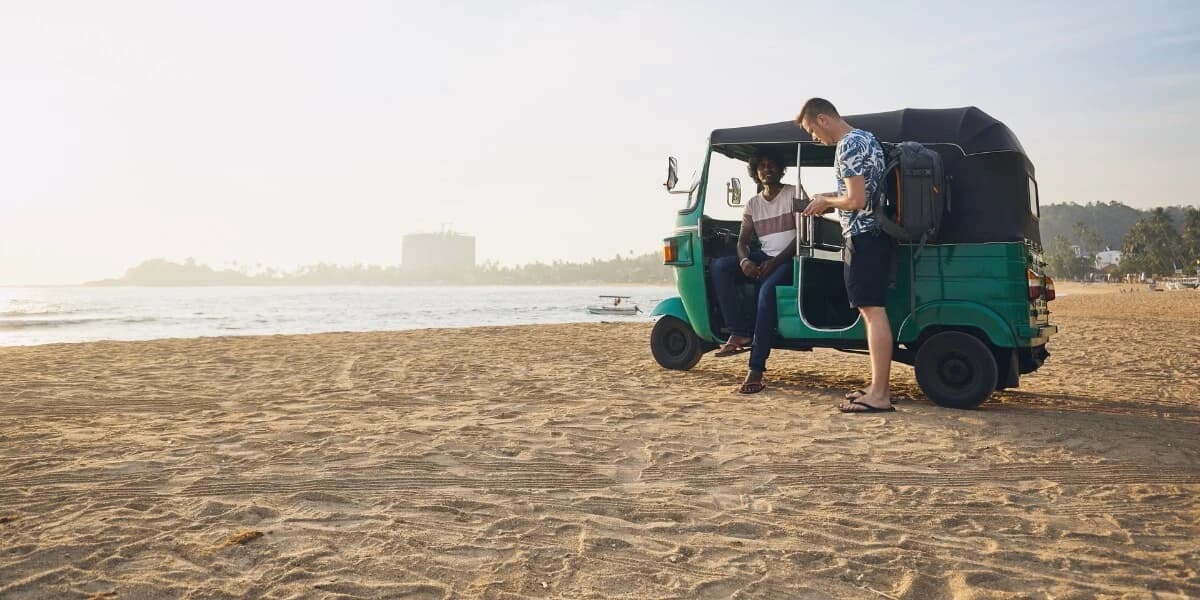
These are small, three-wheeled vehicles, most commonly the Bajaj RE model, powered by either petrol or increasingly by electric motors. They seat two to three passengers comfortably behind the driver (though you'll regularly see entire families packed in). They have no doors, no seatbelts, and no air conditioning — just an open cabin, a puttering engine, and the warm wind of Sri Lanka rushing past your face.
They're everywhere. Over 1.2 million of them are registered across the island. In cities, towns, villages, beach roads, mountain hairpins, temple precincts — if there's a road, there's a three-wheeler on it.
And for travellers, they are the single most common way to get around for short to medium distances.
The Two Ways to Use a Tuk Tuk in Sri Lanka
Before we talk prices, you need to understand that there are two completely different ways to use a tuk tuk here, and the costs are wildly different.
Option 1: Hiring a tuk tuk ride — You flag one down on the street, use an app like PickMe, or ask your hotel to call one. The driver takes you somewhere. You pay for the ride. This is how most travellers use tuk tuks for day-to-day trips: getting to a restaurant, going from the train station to your guesthouse, popping into town for supplies.
Option 2: Renting a tuk tuk — You rent the vehicle itself, get a Sri Lankan temporary driving permit, and drive it yourself across the island for days or weeks. This is a completely different experience — more like a road trip than a taxi ride — and the costs, logistics, and adventure factor are on another level entirely.
I'll cover both in detail. Let's start with the one most people need first.
Tuk Tuk Ride Prices: What You Should Actually Pay
The Meter Rate
By law, all tuk tuks in Sri Lanka are supposed to have meters. The reality is more nuanced — in Colombo and other major cities, metered rides are common. In smaller towns, beach areas, and tourist hotspots, you'll encounter more unmetered, negotiated fares.
The approximate metered rate as of 2026 is around LKR 100 for the first kilometre, and LKR 80-100 per kilometre after that. These rates have fluctuated with fuel prices in recent years, but this range holds true for most of the country.
To put that in real money: a 5-kilometre metered ride costs roughly LKR 400-500, which is about $1.30-$1.70 USD.
Yes. Under two dollars for a private ride across town.
Also check OneCeylon's TukTuk Fair Price Reporter
What Rides Actually Cost in Practice
Here's what real tuk tuk rides tend to cost in different situations. These are based on 2026 traveller reports and local pricing.
Short hops (1-3 km): LKR 200-400 (roughly $0.65-$1.35 USD). This covers things like getting from your hotel to a nearby beach, from a guesthouse to the town centre, or from a bus stop to your accommodation. In tourist areas, expect to pay toward the higher end.
Medium rides (5-10 km): LKR 500-1,000 ($1.70-$3.40 USD). This might be a ride from Hikkaduwa centre to a surf spot down the coast, or from Tissamaharama to the edge of Yala National Park, or from your Kandy hotel to the Botanical Gardens.
Longer trips (15-25 km): LKR 1,500-3,000 ($5-$10 USD). Some travellers use tuk tuks for longer intercity hops where buses are inconvenient. At these distances, it's worth negotiating a flat rate upfront rather than relying on the meter.
Half-day hire (3-4 hours): LKR 3,000-5,000 ($10-$17 USD). If you want a driver to take you around a city or area for a few hours — visiting multiple temples in Kandy, for instance, or doing a food crawl in Galle — a half-day hire is excellent value. Agree on the price and general itinerary before you set off.
Full-day hire: LKR 5,000-8,000 ($17-$27 USD). A tuk tuk driver for the entire day, picking you up in the morning and dropping you off in the evening. This works beautifully for exploring areas like the Cultural Triangle, the south coast, or hill country towns. The driver waits while you explore each stop.
The Tourist Price vs. The Local Price
I'm going to be honest with you about something that most travel guides dance around.
There is a tourist price and a local price. They are not the same. And that's okay.
A Sri Lankan getting a metered ride in Colombo might pay LKR 80 per kilometre. A foreigner flagging down an unmetered tuk tuk in Galle Fort might be quoted LKR 400 for a ride that's objectively worth LKR 200.
Is this "scamming"? I don't think so — at least not usually. It's a reality of travelling in a country where the average tuk tuk driver earns around LKR 2,000-3,000 per day (roughly $7-$10 USD), and where a tourist's daily budget might be ten or twenty times that.
The key is knowing the ballpark so you can negotiate fairly — not brutally, just fairly. If a ride should cost LKR 300 and you're quoted LKR 500, you're not being robbed. If you're quoted LKR 1,500, you're being taken for a ride in more ways than one.
Here's my personal rule: I never haggle below a fair local rate, and I don't lose sleep over paying 20-30% above it. The difference usually amounts to less than a dollar. It means more to the driver than it does to me.
How to Get Fair Prices Every Time
Use the PickMe App
This is the single best thing you can do to avoid pricing confusion. PickMe is Sri Lanka's homegrown ride-hailing app — think of it as the local Uber. You enter your pickup and destination, the app calculates a fare, and a nearby driver accepts the ride.
The prices on PickMe are generally lower than what you'd negotiate on the street, because the app uses standardised per-kilometre rates. It also eliminates the negotiation dance entirely, which is a relief if you're tired, jet-lagged, or just not in the mood.
A few things to know about PickMe: it works well in Colombo, Kandy, Galle, and most larger towns. In rural areas and very small villages, coverage can be spotty or non-existent. Some drivers prefer cash over card payments — if you set the app to card payment, don't be surprised if a driver asks you to cancel and rebook with cash. This is because the app takes a commission on digital payments.
Agree on the Price Before You Get In
If you're flagging down a tuk tuk on the street — which you absolutely will, because sometimes there's no app coverage and there's a three-wheeler right there with a smiling driver — always agree on the fare before you sit down.
This isn't confrontational. It's expected. A simple "How much to [destination]?" followed by either acceptance or a gentle counter-offer is completely normal in Sri Lanka. If the first price sounds too high, suggest what you think is fair. If you can't agree, smile and walk away. Another tuk tuk will appear within 60 seconds. It's Sri Lanka.
Ask Your Hotel
Most guesthouses, homestays, and hotels have relationships with tuk tuk drivers. The prices are usually fair (hotels don't want their guests complaining), and the drivers are vetted. This is often the most hassle-free option, especially for airport transfers or longer day trips.
Some upscale hotels have their own fleet of three-wheelers. These will be more expensive than street hires, but they're immaculately maintained and the service is reliable.
Know the Route
If you have a general sense of the distance — and Google Maps makes this trivially easy — you can quickly estimate whether a quoted price is reasonable. At roughly LKR 80-100 per kilometre, a 10-kilometre ride should cost around LKR 800-1,000. If you're quoted LKR 2,000, you know something's off.
Common Tuk Tuk Routes and What They Cost
To give you a concrete reference, here are some popular tourist routes and their approximate tuk tuk costs in 2026.
Colombo Airport to Negombo: 15-20 km, roughly LKR 2,000-3,000 ($7-$10). Many travellers take this as their first ride in Sri Lanka.
Kandy city to Temple of the Tooth: 2-3 km, roughly LKR 200-400 ($0.65-$1.35).
Galle Fort to Unawatuna Beach: 5 km, roughly LKR 500-800 ($1.70-$2.70). Be aware that tuk tuks originating inside Galle Fort sometimes charge inflated minimums — LKR 400 just to start. Walking outside the fort gates and flagging one down there can save money.
Mirissa to Weligama: 5 km, roughly LKR 400-600 ($1.35-$2).
Ella town to Nine Arches Bridge: 3-4 km, roughly LKR 300-500 ($1-$1.70).
Tissamaharama to Yala National Park entrance: 20 km, roughly LKR 1,500-2,500 ($5-$8.50). Many safari operators include this transfer, so check before booking a separate tuk tuk.
Dambulla to Sigiriya: 17 km, roughly LKR 1,500-2,500 ($5-$8.50).
Anuradhapura to Wilpattu National Park: 30 km, roughly LKR 3,000-4,000 ($10-$13.50).
These are estimates. Prices shift with fuel costs, tourist season demand, time of day, and frankly, the mood of the driver. But they should keep you in the right neighbourhood.
Renting a Tuk Tuk: The Self-Drive Adventure
Now let's talk about the other way — the way that turns a tuk tuk from a taxi into a travel companion.
Renting a tuk tuk and driving it yourself across Sri Lanka has become one of the island's most iconic travel experiences. It's not for everyone. But for the right person — someone who loves freedom, doesn't mind a little chaos, and wants to see the country at ground level — it's genuinely transformative.
What It Costs to Rent
Rental prices in 2026 typically range from $14-$28 USD per day, depending on the duration of your rental, the type of vehicle, and the rental company. The general rule is simple: the longer you rent, the cheaper the daily rate.
For a standard Bajaj RE (the classic manual three-wheeler), expect roughly $18-$25 per day for a 1-2 week rental. Longer rentals of 3-4 weeks can drop to $14-$20 per day. Convertible ("cabrio") and electric models cost more — up to $28 per day.
Here's a realistic full-cost breakdown for a two-week rental:
The tuk tuk rental itself runs approximately $250-$350 depending on the provider. On top of that, you'll pay around $40 for the mandatory Sri Lankan temporary driving permit. Insurance is usually included in the base rental, with a refundable security deposit of $150 at most companies. Fuel will cost you roughly $50-$70 for the entire two weeks, assuming you cover about 1,000 kilometres (tuk tuks are remarkably fuel-efficient, averaging about 4-5 litres per 100 km at around $1 USD per litre). Finally, factor in $10-$45 for pick-up and drop-off transfers if your start and end points are in different locations.
Total for a two-week self-drive tuk tuk adventure: approximately $400-$550 USD all-in.
Compare that to hiring a private car and driver — which runs approximately LKR 140 per kilometre (about $0.47 USD/km) plus the driver's daily food and accommodation — and the tuk tuk starts looking like exceptional value, especially for couples or friends who can split the cost.
The Licence Situation
You cannot just rent a tuk tuk and drive off. You need a Sri Lankan temporary driving permit that specifically covers three-wheelers.
To get this, you need a valid driving licence from your home country (at minimum category B — a regular car licence) and a physical International Driving Permit (IDP). As of 2026, digital or electronic IDPs are not accepted. The IDP must be the original printed document, issued under the 1949 Geneva Convention.
Your rental company can arrange the temporary permit through the Automobile Association of Ceylon (AAC). This typically costs around $30-$40 and should be arranged at least a week before your pick-up date. Most reputable rental companies handle this process for you — you submit your documents, they do the paperwork, and the licence is ready when you collect the tuk tuk.
What to Know Before You Drive
Let me be real: driving in Sri Lanka is an experience. Traffic moves on the left. Buses are enormous and operate under the apparent belief that they are immortal. Cows wander across highways. Dogs sleep in the middle of the road. And the horn isn't a sign of aggression — it's a friendly notification that says "I'm here, please don't kill me."
Tuk tuks are legally limited to 40 km/h. Most drivers creep up to 50-55 in practice, but going faster than that in a vehicle with no doors, no seatbelts, and a high centre of gravity is genuinely risky.
This means distances take longer than you'd expect. Budget for 2-3 hours of driving per day maximum if you want to actually enjoy the journey. The whole point of a tuk tuk road trip isn't speed — it's immersion.
A few survival tips from people who've done it: never drive after dark (wild animals, including elephants, are a real hazard on rural roads at night). Always give way to buses — they will not stop for you. Carry small notes for fuel stops. The fuel price is fixed nationwide at all stations, so you'll never overpay for petrol. And keep your fuel tank above a quarter — tuk tuks have small tanks (about 6 litres) that drain fast on mountain roads.
Should You Actually Do This?
Here's the Jeff Goins answer: if the idea excites you more than it scares you, yes.
Driving a tuk tuk through Sri Lanka's hill country — past tea plantations glowing green in the morning mist, through villages where kids wave and dogs chase you for sport, along coastal roads where the Indian Ocean crashes against rocks just metres away — is one of those travel experiences that lodges itself permanently in your identity.
You come home and people ask, "What did you do in Sri Lanka?" And you say, "I drove a tuk tuk across the whole country."
And they look at you differently. Because now you're the kind of person who does things like that.
But it's not for everyone. If you're uncomfortable with manual transmission vehicles, nervous about chaotic traffic, travelling with very young children, or on a very tight schedule, hiring a private driver or using a combination of trains, buses, and short tuk tuk rides might be a better fit.
Tuk Tuk vs. Other Transport: A Quick Comparison
Tuk tuk ride vs. bus: Buses are incredibly cheap — often LKR 50-200 for journeys that would cost LKR 500-2,000 by tuk tuk. But buses are crowded, follow fixed routes, stop constantly, and don't go door-to-door. Tuk tuks win on convenience, lose on price.
Tuk tuk ride vs. PickMe car: PickMe also offers car rides (sedans, minivans), which are more comfortable and air-conditioned but roughly 40-60% more expensive than a tuk tuk on the same route. For longer rides or in the heat, it's worth considering.
Self-drive tuk tuk vs. private car and driver: A car and driver costs approximately LKR 140 per kilometre for a sedan (about $0.47/km), and you'll need to cover the driver's food and accommodation (roughly $10/night). For a two-week tour covering 1,000 km, that's about $470 in mileage alone plus driver costs — similar to a tuk tuk rental but with far less adventure and far more comfort.
Tuk tuk vs. train: Sri Lanka's trains — especially the Kandy-to-Ella route — are legendary. Beautiful, cheap, and slow in the best possible way. They complement tuk tuks perfectly. The ideal Sri Lanka transport strategy is trains for the scenic long hauls, tuk tuks for everything else.
Tipping Tuk Tuk Drivers
This comes up a lot, so let me address it directly.
Tipping is not expected in Sri Lanka for standard tuk tuk rides. If the metered fare is LKR 350, you're not obligated to add anything extra.
That said — and this is important — tuk tuk drivers in Sri Lanka are not wealthy. The average daily income for a working driver is around LKR 2,000-3,000. Rounding up a fare, adding LKR 100-200 on a longer ride, or tipping a driver who waited for you or went out of his way is a kindness that costs you almost nothing and can genuinely brighten someone's day.
For full-day hires, a tip of LKR 500-1,000 ($1.70-$3.40) on top of the agreed fare is a generous and appreciated gesture.
My approach: I tip when the service was good, the driver was friendly, or the ride was long. I don't feel guilty when I don't. No one in Sri Lanka will be offended either way.
Scams to Watch For (and How to Avoid Them)
Most tuk tuk drivers in Sri Lanka are honest, hardworking people trying to earn a living. But every tourist destination has its share of hustles, and it's better to know about them upfront.
The "no change" trick. You hand over a LKR 1,000 note for a LKR 300 ride. The driver says he has no change. This is almost never true — but it works because most tourists shrug and let them keep it. Solution: carry small notes (LKR 100s, 200s, 500s).
The "meter is broken" claim. In tourist areas, drivers may tell you the meter doesn't work and quote a flat rate that's 2-3x the actual fare. The meter might genuinely be broken, or it might not. Solution: if the quoted price seems high, say no thank you and try the next tuk tuk. Or use PickMe.
The commission hustle. A driver offers to take you to a "great" restaurant, jewellery shop, or spice garden — sometimes even for free. The catch: he earns a commission from the business, and you'll pay inflated prices there. Solution: decide where you want to go before you get in. If a driver insists on detours, be firm.
The Galle Fort premium. Tuk tuks operating inside Galle Fort are known for charging significantly higher rates — sometimes LKR 400 or more just as a starting fare. This is an informal cartel, not an official policy. Solution: walk to the fort's main gate, exit, and flag a tuk tuk on the street outside.
None of these are dangerous. They're just annoying. And once you know about them, they're easy to dodge.
Also check Common Scams in Sri Lanka
The Real Cost of a Tuk Tuk in Sri Lanka
Let me pull this all together with a simple summary.
If you're using tuk tuks for daily rides around a single area, expect to spend LKR 500-2,000 per day on three-wheeler transport — that's roughly $1.70-$7 USD. For a two-week trip, your total tuk tuk ride budget might be $30-$80.
If you're hiring a tuk tuk and driver for day trips, budget LKR 3,000-8,000 per day ($10-$27 USD).
If you're renting and driving yourself for two weeks, the all-in cost is approximately $400-$550, which works out to $28-$39 per day including fuel, licence, and deposit.
By almost any measure, this is some of the cheapest, most cheerful transport you'll find anywhere in the world.
The Thing Nobody Mentions
I want to end with something that isn't about money.
The best tuk tuk rides in Sri Lanka aren't the ones where you got the perfect price. They're the ones where the driver took a shortcut through a village you'd never have found on your own. Where he stopped the engine at a roadside fruit stand and bought you a wood apple "because you must try." Where he turned up the radio and you both listened to baila music bouncing off the walls of a tunnel.
In Sri Lanka, a tuk tuk isn't just transportation. It's a doorway. It's a conversation starter. It's a front-row seat to ordinary life — the schoolkids in white uniforms walking single file, the temples draped in prayer flags, the grandmother sweeping her front step at dawn.
You can obsess over whether you paid LKR 100 too much. Or you can lean back, feel the wind, and watch the most beautiful island in the Indian Ocean scroll past like a film only you get to see.
I know which one I'd choose.
Prices in this guide reflect conditions as of early 2026 and may change with fuel price adjustments or government rate revisions. For real-time fares, download the PickMe app before your trip.