Most people arrive on this island expecting "Indian food, but different." They leave knowing that Sri Lankan cuisine is its own universe entirely — one built on coconut, built on fire, built on a spice trade that once drew the Portuguese, the Dutch, and the British to these shores. The curries are darker. The flavours are bolder. And the variety, from a single rice and curry plate, is staggering enough to ruin you for every other lunch you'll ever eat.
This is not a polite list of dishes you "should" try. This is a field guide to what you must eat, where exactly to eat it, and how to avoid the tourist-menu version that tastes like someone apologised for the chilli.
We've eaten our way from Colombo to Jaffna, from Galle Fort to Hiriketiya beach shacks, across three years of living on this island. Here's what survived the cut.
How Sri Lankan Food Works: A 60-Second Primer
Before you dive into the dishes, understand the system. Sri Lankan cuisine runs on three pillars: coconut (the oil, the milk, the flesh — it's in nearly everything), rice (the foundation of every proper meal), and spice (not just heat, but depth — cinnamon, cardamom, fenugreek, mustard seed, curry leaf, and pandan).
The curries break into three colour categories. White curries are coconut-milk based, mild, and creamy — potatoes, eggs, and certain vegetables are often prepared this way. Red curries bring the heat with chilli and are the standard for most meats and fish. Black curries are dry-roasted and intense, with dark spice blends that caramelise into something smoky and complex — pork and beef are magnificent done this way.
Every meal is an ensemble. You don't order "a curry." You order rice and receive a small civilisation of dishes around it: three, five, sometimes eight different curries, sambols, mallum (chopped greens with coconut), and crispy accompaniments. You mix. You experiment. You eat with your right hand if you want the full experience.
Now, the dishes.
Breakfast Dishes
1. Egg Hoppers (Appa with Egg)

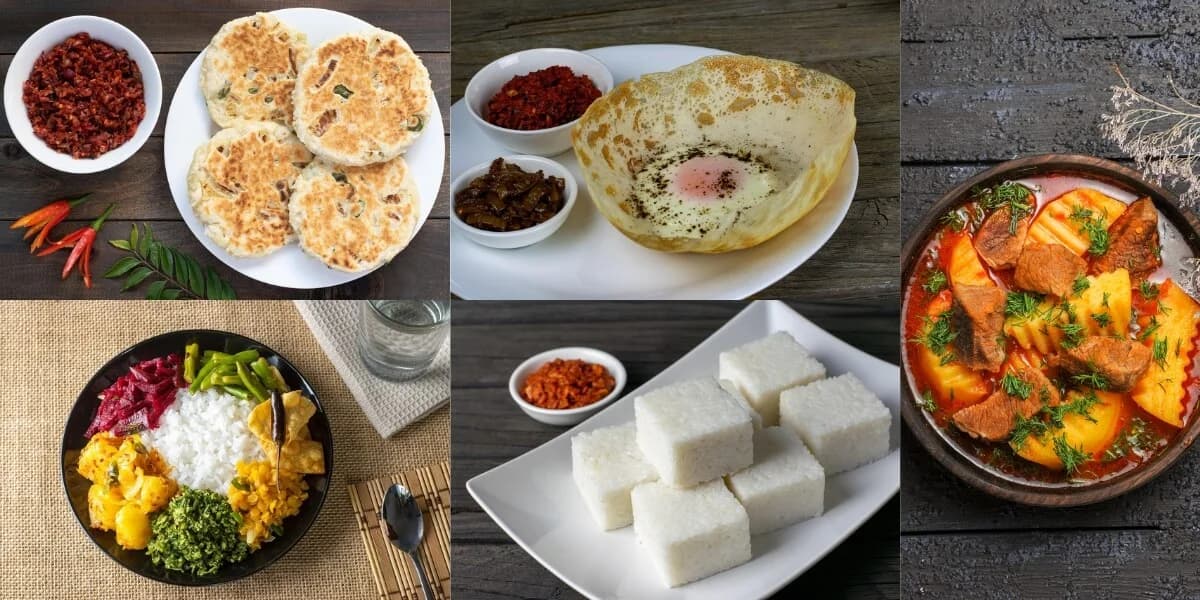
A hopper is a bowl-shaped pancake made from fermented rice flour and coconut milk, cooked in a small wok-like pan until the edges turn golden and crisp while the centre stays soft and pillowy. Crack an egg into the middle as it cooks, and you have Sri Lanka's most perfect breakfast.
Eaten with lunu miris (a raw sambol of chilli, onion, lime, and Maldive fish) and a coconut milk-based dhal curry, the egg hopper is the dish that converts every visitor on day one. The fermentation gives the batter a slight tang that no Western pancake can replicate.
Where to eat it: Roadside hopper stalls across the country serve the most authentic versions — look for the ones with queues of locals at 7 AM. In Colombo, Culture Colombo offers a tasting basket with hoppers, string hoppers, and accompaniments that works beautifully as an introduction. In the south, beach-town guesthouses almost universally serve them for breakfast — ask your host to make them fresh.
Cost: 50–100 LKR ($0.15–0.30) at a street stall; 400–800 LKR ($1.20–2.50) at a cafe.
2. String Hoppers (Idiyappam)

Despite the name, string hoppers share almost nothing with regular hoppers except rice flour. These are thin noodles pressed through a mould and steamed into delicate flat discs — soft, light, and designed to soak up curry like edible sponges.
Served for breakfast or dinner, string hoppers come stacked in piles alongside coconut milk dhal and pol sambol (the spicy grated coconut condiment that appears at nearly every Sri Lankan meal). The texture is gentle and comforting — the kind of dish that makes you wonder why the rest of the world hasn't caught on.
Where to eat it: Culture Colombo includes them in their traditional breakfast sets. Any local "hotel" (Sri Lankans call small restaurants "hotels") will serve string hoppers as a breakfast or dinner staple.
Cost: 150–300 LKR ($0.50–1.00) at local spots.
3. Pol Roti (Coconut Flatbread)

A thick, slightly charred flatbread made with flour and grated coconut — denser and more satisfying than the plain roti served at tourist restaurants. Pol roti is what Sri Lankans actually eat for breakfast, torn into pieces and dipped into lunu miris or a fiery chicken curry.
The key distinction: pol roti is not the thin, stretchy roti you'll find at beach shacks catering to tourists. It's coarser, coconut-rich, and has a toasted, almost nutty flavour. If the menu just says "roti" without the "pol," you're getting the wrong thing.
Where to eat it: In Colombo, The Cauldron does an excellent version. But the best pol roti is almost always at your guesthouse or a roadside bakery — the kind of place with no English sign and a queue of three-wheelers parked outside at 6 AM.
Cost: 30–80 LKR ($0.10–0.25) at local bakeries.
4. Kiribath (Milk Rice)

Rice slow-cooked in thick coconut milk until creamy and sticky, then pressed flat and cut into diamond shapes. Kiribath is ceremonial food — Sri Lankans prepare it for New Year, weddings, births, new jobs, and any occasion that marks a beginning.
Eaten with lunu miris for a savoury hit or simply with sugar for something sweeter, kiribath is comfort food in its purest form. It's also dead simple, which is why Sri Lankan grandmothers consider it the one dish everyone should be able to make.
Where to eat it: Most hotel and B&B breakfasts include kiribath — just ask if it's not on the buffet. You'll also find it at Hela Bojun food stalls (government-backed collectives run by local women, found across the island).
Cost: 100–200 LKR ($0.30–0.60) at local spots.
The Main Event: Rice, Curry & Beyond
5. Rice and Curry

This is not a single dish. It's the entire philosophy of Sri Lankan eating, compressed onto one plate.
You receive a mound of rice — white, red, or sometimes yellow — and around it, an ecosystem: a fish or meat curry, two or three vegetable curries, a dhal, pol sambol, papadum, and possibly a mallum (finely chopped greens mixed with grated coconut). You mix everything with your fingers. Each bite is a different combination.
The beauty is that no two rice and curry plates are identical. Every household, every restaurant, every roadside stall has its own rotation of curries depending on what's fresh. Monday's lunch might feature jackfruit and beetroot curries; Tuesday brings pumpkin and snake gourd. The only constant is that the dhal will be coconut-milk rich and the sambol will make your eyes water.
Where to eat it: For the authentic Colombo experience, Upali's by
Nawaloka is the standard recommendation — traditional recipes, reasonable prices, and consistently good quality. For budget-friendly perfection, Hotel De Pilawoos in Colombo serves until late and draws enormous local crowds. On the south coast, any place where you see Sri Lankans eating lunch is the right place. Expect to pay 250–400 LKR ($0.80–1.25) at a local "hotel" for a full plate with refills.
Cost: 250–500 LKR ($0.80–1.50) at local restaurants; 1,500–3,000 LKR ($4.50–9.00) at tourist-oriented spots.
6. Kottu Roti

The dish that announced itself by sound before we even mentioned it. Kottu is Sri Lanka's ultimate street food: chopped godhamba roti stir-fried on a flat griddle with vegetables, egg, spices, and your choice of chicken, beef, cheese, or vegetables.
The preparation is theatre. Two heavy metal cleavers rhythmically chop and turn the ingredients on a searing hot plate. The sound carries down the street. You hear the kottu being made two blocks away and follow it like a dinner bell.
Cheese kottu — with stretchy, melted cheese layered through the spiced roti — is the decadent variant that visitors tend to fall hardest for. But the classic egg and vegetable version is what Sri Lankans eat most nights as a quick, filling dinner.
Where to eat it: Hotel De Pilawoos in Colombo is legendary for kottu and stays open late. In Galle, Food Cycle does a popular cheese kottu with theatrical preparation. In any town across the island, listen for the sound after 6 PM and follow it.
Cost: 300–600 LKR ($1.00–2.00) at street stalls; 800–1,500 LKR ($2.50–4.50) at restaurants.
7. Fish Curry (Malu Curry)

Sri Lanka is an island. Fish curry is its soul.
The standard preparation uses firm white fish (often tuna or mackerel), marinated in turmeric and chilli, then simmered in a sauce built from coconut milk, goraka (a dried tamarind-like fruit unique to Sri Lankan cooking), curry leaves, and a complex spice blend. The result is rich, slightly sour, and deeply aromatic.
Each region does fish curry differently. The south coast version tends to be more coconut-heavy. The northern Jaffna-style uses more tamarind and less coconut milk, producing a thinner, more intensely spiced sauce. Both are magnificent.
Where to eat it: Seafood shacks along the south coast — Mirissa, Galle, and Weligama — all serve excellent versions. In Colombo, Upali's does a reliable traditional preparation. For the Jaffna style without travelling north, Palmyrah Restaurant inside the Renuka Hotel in Colombo specialises in northern Sri Lankan cuisine.
Cost: 400–800 LKR ($1.25–2.50) at local spots; 1,500–3,500 LKR ($4.50–10.50) at upscale restaurants.
8. Ambul Thiyal (Sour Fish Curry)

If regular fish curry is the everyday workhorse, ambul thiyal is the showpiece. Cubes of firm tuna are slow-cooked with black pepper, turmeric, cinnamon, garlic, curry leaves, and the signature ingredient — dried goraka — which gives the dish its distinctive sour tang and acts as a natural preservative.
The result is dry rather than saucy, intensely flavoured, and dark. It's a dish that was originally designed to last for days without refrigeration in Sri Lanka's tropical heat — a testament to the ingenuity of Sri Lankan home cooks.
Where to eat it: The south coast, particularly around Galle and Mirissa, is where ambul thiyal is at its best — the proximity to fresh tuna makes a difference. Local seafood restaurants in these towns serve it as a regular lunch item.
Cost: 500–1,000 LKR ($1.50–3.00) at local restaurants.
9. Lamprais

The most elaborate takeaway meal you'll ever encounter. Lamprais is a Burgher (Dutch-Sri Lankan) invention: rice cooked in stock, wrapped in a banana leaf with a specific set of accompaniments — mixed meat curry, frikkadels (spicy meatballs), blachang (dried prawn paste), seeni sambol (caramelised onion relish), and brinjal pahi (pickled eggplant) — then baked.
The banana leaf imparts a subtle, grassy flavour to everything inside. Opening a lamprais parcel is like unwrapping a gift that contains an entire cuisine in miniature. Each component is distinct, but together they produce something greater than the sum.
Lamprais is not fast food. It's prepared in advance and sold from specific shops, often only at lunchtime, often running out by 1 PM.
Where to eat it: In Colombo, the VOC Cafe at the Dutch Burgher Union is the gold standard — recipes passed through generations of the Burgher community. They serve it strictly at lunch, and locals know to arrive early. Perera and Sons bakery chain also sells a decent mass-market version.
Cost: 500–1,000 LKR ($1.50–3.00) at specialist shops.
10. Devilled Dishes (Devilled Chicken, Prawns, or Pork)

"Devilled" is Sri Lanka's answer to the question: what happens when you stir-fry meat with an aggressive amount of chilli, capsicum, onion, and a sweet-spicy sauce? The answer is something addictive, slightly sticky, and perfect with a cold beer.
Devilled chicken is the most common variant, but devilled prawns are the south coast favourite, and devilled pork has a cult following in Colombo. The sauce balances sweet (often ketchup or palm sugar), sour (lime or vinegar), and heat (dried red chilli) in a way that's uniquely Sri Lankan — halfway between a Chinese stir-fry and a Caribbean pepper sauce.
Where to eat it: Virtually every restaurant in Sri Lanka serves some version. In Colombo, Upali's does a well-executed devilled chicken. On the south coast, order devilled prawns at any beachside restaurant and you'll rarely be disappointed.
Cost: 600–1,200 LKR ($1.80–3.60) at local restaurants.
11. Crab Curry (Kakuluwo)

Sri Lanka's lagoon crabs are famous for their sweet, succulent meat — and the country's crab curry has become a global talking point, largely thanks to Colombo's Ministry of Crab, which has appeared on Asia's 50 Best Restaurants list.
The preparation ranges from chilli crab (fiery, tomato-based) to pepper crab (buttery, cracked-peppercorn-rich) to traditional Sri Lankan crab curry (coconut milk, spices, and a deep, slow-cooked gravy). Sizes range from modest to the genuinely alarming "Crabzilla" at over two kilograms.
Where to eat it: In Colombo, Ministry of Crab in the Dutch Hospital precinct is the famous choice — book well in advance and budget $30–50 per person. For a more affordable experience, New Banana Leaf in Colombo serves excellent crab curry at local prices. On the south coast, the seafood restaurants in Negombo and Mirissa serve fresh crab in traditional preparations.
Cost: 500–1,500 LKR ($1.50–4.50) at local spots; 5,000–15,000 LKR ($15–45) at Ministry of Crab.
12. Biriyani (Sri Lankan Style)

Biriyani exists across South Asia, but the Sri Lankan version has its own fingerprint. The rice is fragrant with saffron, cardamom, and cinnamon. The meat — usually chicken or mutton — is spiced with a specifically Sri Lankan blend. And it arrives with a set of accompaniments you won't find elsewhere: mint chutney, Malay pickle (a sweet-sour fruit and vegetable pickle unique to Sri Lanka's Malay community), a boiled egg, and a slice of pineapple.
Where to eat it: Biriyani shops across Colombo's Pettah neighbourhood sell freshly prepared portions, usually only during lunch hours. The dish disappears from menus by mid-afternoon, so time your visit accordingly.
Cost: 400–800 LKR ($1.25–2.50) at local biriyani shops.
Sides, Sambols & Condiments
13. Pol Sambol (Coconut Sambol)

The one condiment that unites every Sri Lankan meal. Freshly grated coconut mixed with red chilli flakes, onion, lime juice, and Maldive fish (dried tuna), then pounded together into a bright, fiery, coconut-rough paste.
Pol sambol appears with hoppers, with rice, with roti, with string hoppers — with everything. The balance between the sweetness of the coconut and the fire of the chilli is what separates a good pol sambol from a great one. When it's made fresh and served alongside a crispy egg hopper, there is no better condiment on earth.
Where to eat it: Everywhere. Literally every meal in Sri Lanka should include pol sambol. The best versions are homemade — guesthouse breakfasts typically outperform restaurant versions.
14. Seeni Sambol (Caramelised Onion Sambol)

Where pol sambol is raw and fiery, seeni sambol is slow and sweet. Onions are cooked down with dried chilli, Maldive fish, cinnamon, cardamom, and a touch of sugar until they become dark, sticky, and deeply caramelised.
Seeni sambol is the condiment you didn't know your morning toast needed. It's traditionally served with bread, hoppers, or kiribath, and the complex sweetness makes it the most approachable sambol for spice-shy visitors.
Where to eat it: Breakfast buffets at hotels and guesthouses almost always include it. In Colombo, Culture Colombo uses it generously in their breakfast sets.
15. Gotukola Sambol

A fresh salad-like preparation made from gotukola (a medicinal green leaf), finely chopped with shallots, coconut, lime, chilli, and Maldive fish. It's bright, herby, and believed by Sri Lankans to have significant health benefits — from aiding digestion to improving memory.
Gotukola sambol is the dish that reminds you Sri Lankan food isn't all heat and richness. It's a clean, sharp counterpoint to the heavier curries — the salad course that the rest of the plate desperately needs.
Where to eat it: Any traditional rice and curry lunch will include gotukola sambol or a similar green accompaniment. Hela Bojun food courts serve it alongside their traditional meals.
Street Food & Snacks
16. Isso Vade (Prawn Fritters)

Deep-fried lentil patties topped with a whole prawn — crispy, golden, and spiced with cumin, chilli, and curry leaves. Isso vade is Colombo's signature street snack, synonymous with the Galle Face Green promenade where dozens of vendors set up each evening as the sun sets over the Indian Ocean.
The best isso vade has a crunchy exterior, a soft spiced lentil interior, and a prawn that's still sweet and firm. Eat it standing on the seafront, watching cricket matches play out on the green, with the Galle Face Hotel glowing in the background.
Where to eat it: Galle Face Green in Colombo is the definitive spot — vendors appear from around 5 PM. You'll also find isso vade from vendors on trains and buses across the country.
Cost: 50–150 LKR ($0.15–0.45) each.
17. Short Eats (Pastries and Snacks)

"Short eats" is the Sri Lankan term for the glass-cabinet snacks found at every bakery and tea shop on the island: fish cutlets, vegetable rolls, mutton patties, Chinese rolls, and dozens of other deep-fried or baked parcels of filling wrapped in pastry.
Walk into any Perera and Sons bakery — there are branches everywhere — and point at what looks good. A fish cutlet (a breadcrumb-coated, deep-fried ball of spiced fish and potato) is the essential starting point. Pair it with a cup of sweet, milky Sri Lankan tea for the full experience.
Where to eat it: Perera and Sons for reliable quality across the island. But any local bakery with a glass display cabinet is fair game — the turnaround is fast, so things are usually fresh.
Cost: 50–150 LKR ($0.15–0.45) per piece.
18. Achcharu (Pickled Fruit)

Sour, spicy, and sweet all at once — achcharu is Sri Lanka's answer to Mexican chilli mango. Fresh fruits (green mango, pineapple, gooseberry, olive) are chopped and tossed with chilli powder, salt, and lime juice, then served in small bags from street carts.
It's an acquired taste for Western palates, but once you acquire it, you'll find yourself craving it at 4 PM every day. The combination of sour fruit and heat is bizarrely refreshing in tropical heat.
Where to eat it: Street vendors at Galle Face Green in Colombo and at bus stations across the island. Also at local markets.
Cost: 50–100 LKR ($0.15–0.30) per bag.
Sweet Endings & Drinks
19. Watalappan (Coconut Custard)

A rich, wobbly custard made from coconut milk, jaggery (unrefined palm sugar), eggs, cardamom, and nutmeg. Watalappan has Malay origins — brought to Sri Lanka by the island's small but influential Malay community — and is the country's most beloved dessert.
The jaggery gives it a deep, caramel-like sweetness that's less cloying than sugar, and the cardamom lifts the whole thing from heavy to fragrant. It's traditionally made for Ramadan and festive occasions, but you'll find it year-round at restaurants that take their dessert menu seriously.
Where to eat it: Traditional restaurants across the island. In Colombo, Nuga Gama at the Cinnamon Grand Hotel serves it alongside other traditional sweets. On the south coast, upscale restaurants in Galle Fort often include it on their dessert menus.
Cost: 200–500 LKR ($0.60–1.50) at restaurants.
20. Kola Kenda (Herbal Porridge)

Part medicinal brew, part breakfast, kola kenda is a thick green porridge made from rice, coconut milk, and a blend of wild leafy greens — including gotukola, hathawariya (wild asparagus), and various herbal plants believed to boost immunity, aid digestion, and provide sustained energy.
It's Sri Lanka's answer to the smoothie bowl — except it's been around for centuries and doesn't cost $14. The flavour is earthy, slightly bitter, and deeply nutritious. It's an acquired taste, but one that grows on you fast.
Where to eat it: Hela Bojun food courts serve it fresh each morning. Some guesthouses in the hill country and rural areas also offer it as a breakfast option.
Cost: 50–150 LKR ($0.15–0.45).
21. Ceylon Tea

You cannot write about Sri Lankan food and not end with tea. Sri Lanka is one of the world's largest tea producers, and the island's tea — still marketed globally as "Ceylon tea" — ranges from the light, floral notes of Nuwara Eliya high-grown teas to the robust, malty character of low-country Sabaragamuwa leaves.
The local way to drink it is strong, brewed with milk and sugar in the cup, served in a small glass. At a roadside tea stall, it costs nearly nothing and tastes better than anything you'll brew at home. The ritual of stopping for a cup of plain tea — sometimes called "plain tea" to distinguish it from the milk version — is woven into the daily rhythm of Sri Lankan life.
For the full experience, visit a tea plantation in the hill country around Nuwara Eliya or Ella. Watch the processing, taste the grades, and buy direct from the source.
Where to drink it: Literally everywhere. Every roadside stall, every train station, every village has tea. For the plantation experience, the Damro Labookellie Tea Centre near Nuwara Eliya offers free tastings and tours.
Cost: 20–50 LKR ($0.06–0.15) at a roadside stall.
You can read our complete guide about Ceylon Tea here.
Quick Reference: What to Eat at Each Meal

How to Eat Like a Local: Practical Tips
Eat with your right hand. Sri Lankans eat rice and curry with their fingers — specifically the right hand. It's not mandatory for tourists, and nobody will judge you for using a spoon, but using your hand genuinely changes the experience. You mix curries into the rice in proportions you control. You feel the textures. It's messier and better.
"Local spicy" is different from "tourist spicy." If you ask for your food "Sri Lankan spicy" at a local restaurant, prepare for a level of heat that most visitors are not ready for. Start by saying "medium spice" and work your way up over a few days. Your tolerance builds fast.
Eat where the locals eat. The best rice and curry in any town is not at the restaurant with the English-language menu and the fairy lights. It's at the small "hotel" with the handwritten sign in Sinhala, the plastic tables, and thirty tuk-tuk drivers eating lunch at noon. Follow the crowd.
Lunch is the main meal. Sri Lankans eat their largest and most elaborate meal at midday. If you want the full rice and curry experience with the widest variety of dishes, eat between 12 PM and 1 PM. By 2 PM, many local restaurants have run out of several curry options.
Hela Bojun is your secret weapon. These government-run food courts, staffed by local women, serve authentic Sri Lankan dishes at some of the lowest prices on the island. The food is freshly prepared, the menus rotate daily, and the quality is consistently excellent. There are locations across the country — ask locally for the nearest one.
Vegetarians and vegans: you're in luck. Because a standard rice and curry meal consists of multiple vegetable dishes, Sri Lanka is one of the easiest countries in Asia for plant-based eating. Coconut milk replaces dairy in most cooking. Just specify "no fish" — Maldive fish (dried tuna) is used in many sambols and vegetable preparations, and it's easy to miss if you don't ask.
The Spice Rack: What Makes Sri Lankan Food Taste Like Sri Lankan Food
Understanding the core spices helps you recognise — and appreciate — what you're eating:

Ceylon cinnamon is milder and more complex than the cassia cinnamon sold in most Western supermarkets. Sri Lanka produces about 80% of the world's true cinnamon, and it appears in curries, desserts, and drinks across the island.

Curry leaves (karapincha) give Sri Lankan curries their distinctive aroma — fresh, slightly citrusy, and completely different from curry powder. They're used fresh, never dried, and typically tempered in hot oil at the start of cooking.

Goraka is a dried fruit used almost exclusively in Sri Lankan cooking. It provides the sour element in dishes like ambul thiyal and is also a natural preservative.

Pandan leaves (rampe) add a sweet, grassy fragrance to rice and curries. Along with curry leaves and lemongrass, they form the aromatic backbone of most Sri Lankan cooking.

Maldive fish is dried, cured tuna imported from the Maldives (and now also produced locally). It's the umami bomb in sambols, curries, and vegetable preparations — the ingredient that makes "vegetable curry" not quite vegetarian in traditional Sri Lankan cooking.
Frequently Asked Questions
What is the most popular food in Sri Lanka? Rice and curry is the national staple, eaten daily by most Sri Lankans for lunch. It consists of rice served with multiple curries, sambols, and accompaniments. Kottu roti is the most popular street food, particularly in the evening.
Is Sri Lankan food very spicy? Traditional Sri Lankan food uses significant chilli, but spice levels vary by dish and region. White curries and hoppers are mild. Red and black curries can be intensely hot. Most restaurants will adjust spice levels for visitors if asked.
What should I eat for breakfast in Sri Lanka? Egg hoppers with lunu miris and dhal curry, string hoppers with pol sambol, pol roti with chicken curry, or kiribath (milk rice). For something lighter, fresh tropical fruit and plain tea.
Is Sri Lankan food suitable for vegetarians and vegans? Yes — Sri Lankan cuisine is one of the most naturally plant-friendly in Asia. The majority of curries in a standard rice and curry meal are vegetable-based, and coconut milk replaces dairy. Ask about Maldive fish (dried tuna), which appears in many vegetable dishes and sambols.
How much does food cost in Sri Lanka in 2026? A full rice and curry meal at a local restaurant costs 250–500 LKR ($0.80–$1.50). Street food snacks like isso vade and short eats cost 50–150 LKR ($0.15–$0.45) each. A meal at a tourist-oriented restaurant runs 1,500–3,500 LKR ($4.50–$10.50). Fine dining in Colombo costs $30–50 per person.
What is the difference between Sri Lankan food and Indian food? While there are shared influences (particularly with South Indian cuisine), Sri Lankan food uses more coconut in its cooking, relies on unique ingredients like goraka and Maldive fish, has a distinct spice profile centred on Ceylon cinnamon and curry leaves, and features dishes like hoppers, kottu, and lamprais that have no direct Indian equivalent.
Where can I take a cooking class in Sri Lanka? Cooking classes are available across the island. The south coast towns of Unawatuna, Galle, and Hiriketiya have popular classes that include market visits and hands-on preparation of 4–6 dishes. Classes typically cost $15–30 per person and last 2–4 hours.
Places Mentioned(9)
Upali's by Nawaloka
65 Dr CWW Kannangara Mawatha, Colombo 00700, Sri Lanka
Culture Colombo
25 Kensington Garden, Colombo 00400, Sri Lanka
Hotel De Pilawoos - Wellawatte
21 Galle Rd, Colombo 00600, Sri Lanka
THE CAULDRON
06, 68 Stratford Ave, Colombo 00600, Sri Lanka
Hela Bojun Hala Battaramulla
WW27+4MX, Battaramulla 10120, Sri Lanka
VOC Cafe
Thunmulla, Dutch Burgher Union, 114 Reid Ave, Colombo 00500, Sri Lanka
Nuga Gama
77 Galle - Colombo Rd, Colombo 00300, Sri Lanka
Galle Face Green
Colombo, Sri Lanka
Labookellie Tea Lounge
2PF9+PHR, A5, Labugolla, Sri Lanka
Tap a place card to see more details • Swipe to see all 9 places