If you ask the average traveler what happens in Sri Lanka in mid-April, they might mention the tropical heat or the perfect surfing waves rolling into Arugam Bay.
But they are missing the greatest spectacle on the island.
On Tuesday, April 14, 2026, Sri Lanka will not just celebrate a New Year. It will execute a staggering, island-wide choreography of ancient astronomy, community harmony, and culinary tradition. It is called the Sinhala and Hindu New Year (Avurudu in Sinhala, Puthandu in Tamil).
Unlike the Western New Year—a boozy, arbitrary midnight countdown—this festival is governed exclusively by the cosmos. It marks the exact moment the sun leaves the house of Pisces and enters Aries, concluding the harvest season.
Here is why anyone with a passport and an appreciation for raw culture needs to understand what happens in April.
1. The "Neutral Time" Where an Entire Island Stops
There is a period—often lasting around 12 hours—between the end of the old year and the dawn of the new one. This is the Punya Kalaya or Nonagathe (the inauspicious time).
During these hours, commerce dies. Kitchen fires are extinguished. Transactions are frozen. The entire country of 22 million people shifts its focus exclusively to religious observances and quiet reflection. Try to find an open store, and you will fail. It is a mandated national pause button. In a world obsessed with perpetual motion, this collective stillness is astonishing to witness.
2. The Power of the Auspicious Minute
When the New Year officially dawns, it does not happen slowly. It happens on the dot.
Astrologers calculate the exact minute for every ritual. At the precise decreed moment, millions of households simultaneously face the designated auspicious direction (carefully mapped out for 2026) and light a new fire to boil a clay pot of milk until it spills over—a symbol of overflowing prosperity.
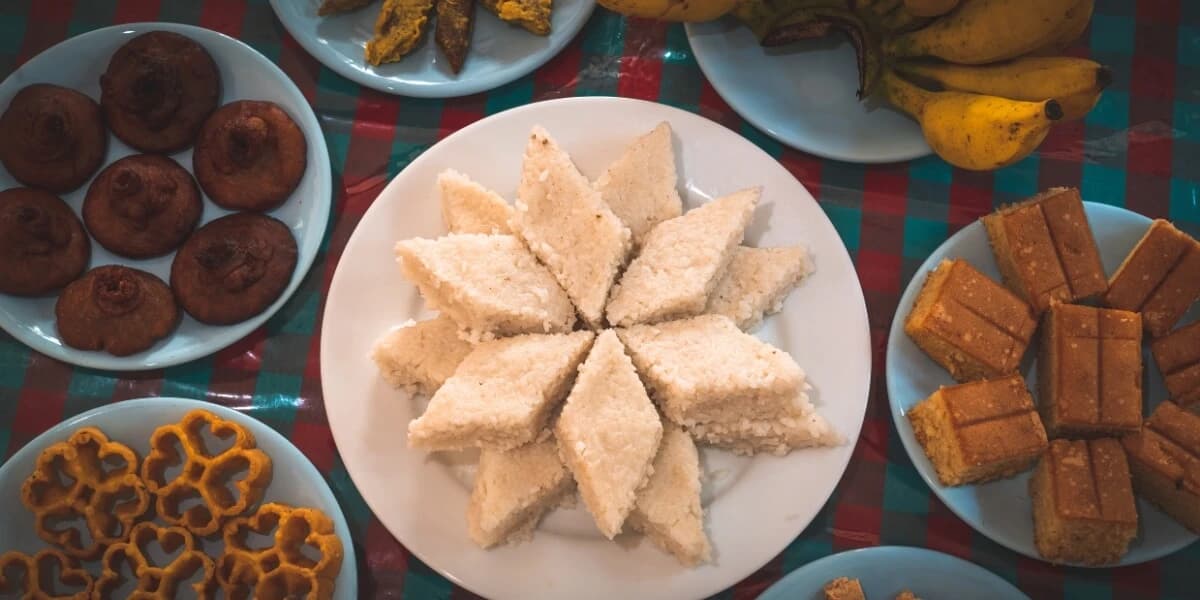
A few hours later, at another exact minute, the island sits down to eat. Imagine an entire country taking its first bite of milk rice (kiribath) and honey-drenched sweetmeats (kavum and kokis) in perfect unison. It is a marvel of collective human behavior.
3. The Blueprint for the 2026 Traveler
If you are visiting Sri Lanka in April 2026, do not expect a standard vacation. The cities empty out as people return to their ancestral villages.
The Tourist Trap: Staying barricaded in a secluded luxury beach resort. You will entirely miss the magic of the season.
The Smart Traveler’s Fix: Book a local homestay or a boutique villa embedded within a village community. When the rhythmic beating of the Rabana (a large traditional drum) starts, and the call of the Asian Koel bird (the Kohaa) fills the air, you want to be invited next door. Sri Lankans are fiercely hospitable; you will be pulled into traditional street games and fed until you cannot move.
The Bottom Line: The Sinhala and Hindu New Year is not just a holiday. It is a masterclass in pausing, resetting, and aligning human life with the natural rhythms of the earth. If you are planning your travels for 2026, circle April 14th on your calendar. It is the day you will see Sri Lanka's true soul.
Places Mentioned(1)
Arugam Bay Beach
Arugam Bay Beach, Sri Lanka
Tap a place card to see more details • Swipe to see all 1 places